
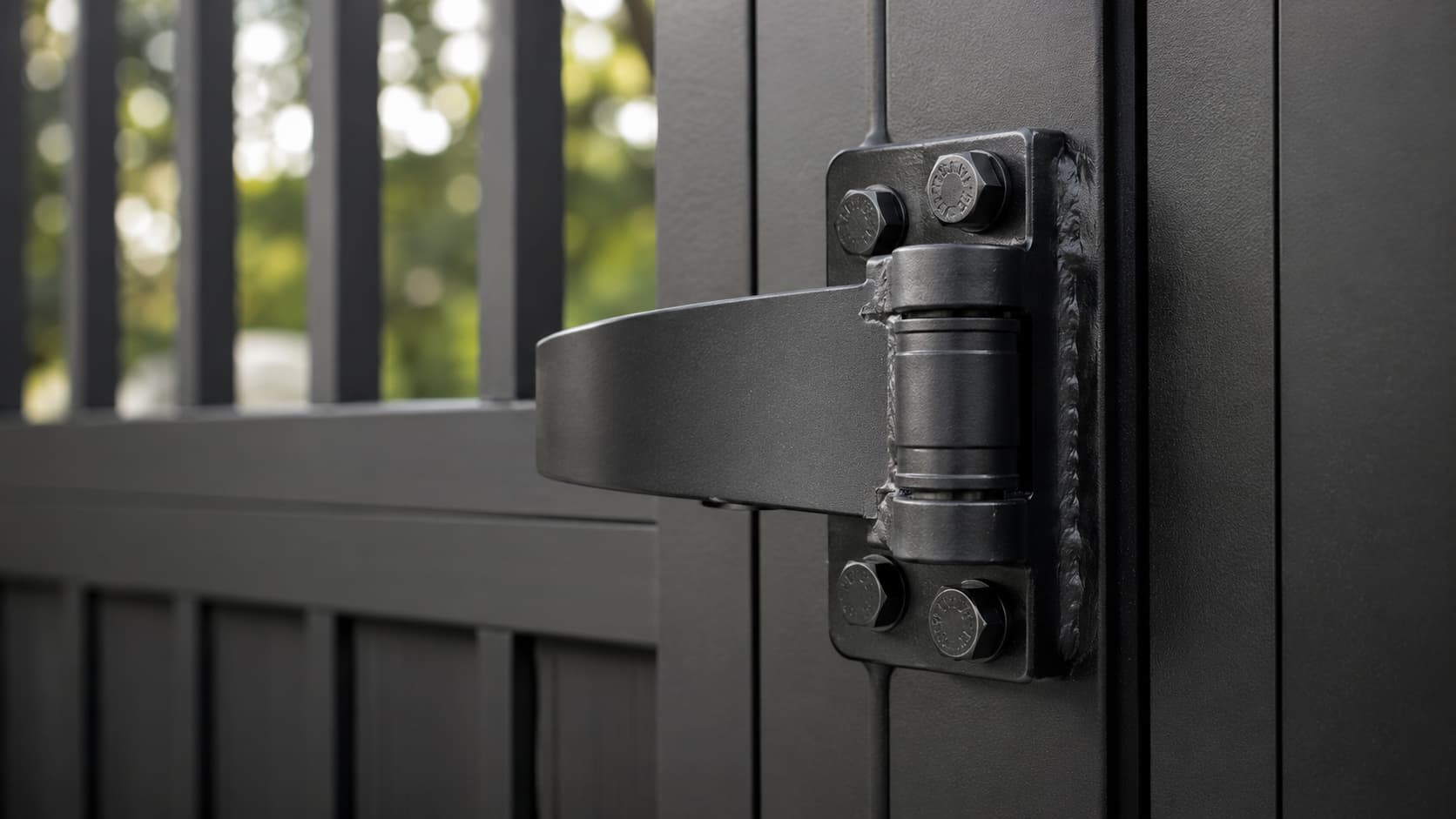
Gate Hardware
Hinges, latches, drop rods, rollers and automation — specified for the weight of your gate, not the size of the box it came in.
Almost every failed gate we get called out to has the same cause: the leaf was built properly and the hardware was not sized for it. A heavy driveway leaf on hardware sized for a garden gate will pull its own post out of alignment, and then out of the ground. We spec the hardware to the actual weight and duty cycle, weld the mounts rather than screwing them on, and grease-fit anything that turns.
Hinges and pivots
Weld-on barrel hinges, adjustable bolt-through hinges and pivot sets for heavy leaves. Adjustable types matter on new construction, where the posts settle and the gate needs a tweak after the first year.
Latches, locks and drop rods
Gravity latches, lockable slam latches, keyed deadlatches and drop rods for bi-parting leaves. Self-closing and self-latching hardware where the gate forms part of a pool enclosure.
Rollers, tracks and automation
V-track and cantilever roller sets for slide gates, plus the mounting plates, brackets and conduit runs an opener needs. We do not sell the operator itself — we build the gate to accept the one your automation installer specifies, and we coordinate with them before anything is welded.
Why Gate Hardware Decides How Long a Gate Lasts
A gate leaf is a lever, and every kilogram of it, plus everything the wind pushes on it, ends up in the hinges. Hardware chosen to the minimum that will hold the gate on day one is the reason so many gates sag, drag and stop latching within a few seasons.
The three things that matter are: hardware sized for the actual leaf rather than the minimum, a post and frame stiff enough that the hardware stays in alignment, and a latch arrangement that still works after the gate has settled. Get those right and a gate is fine in year fifteen.
Hinges and Pivots
Weld-on barrel hinges — the workhorse for steel gates. Strong, adjustable during installation, and repairable. The size is chosen for the leaf weight and the leaf width together, because a wide light gate can load a hinge as hard as a narrow heavy one.
Adjustable hinges allow the gate to be trued up after installation and again after the post settles. On a heavy driveway gate this is worth paying for — it is the difference between a service call and a rebuild.
Bolt-on and bracket hinges for gates fixed to masonry piers, existing posts or where welding on site is not practical.
Pivot arrangements — top and bottom pivots rather than side hinges — used where the gate is heavy, where the leaf has to swing both ways, or where the design wants no visible hinge.
Self-closing hinges where a gate has to close and latch on its own. Where a gate encloses a pool, the self-closing and self-latching requirements and the latch position are set by your municipality and the applicable regulations — confirm them and we build to what they say.
Latches, Locks and Drop Rods
Gravity and lever latches for pedestrian and courtyard gates, chosen for how the gate is used and by whom.
Lockable latches and deadlatches where the gate has to secure. Keying can usually be coordinated with the rest of the property’s hardware — bring your locksmith or your existing keyway into the conversation early.
Drop rods and cane bolts hold one leaf of a double gate while the other operates. The receiver in the ground matters as much as the rod: a receiver that fills with grit stops being used within a year, and one set into a puddle rusts out.
Slide bolts and shoot bolts for secondary securing, and for holding a leaf open in wind.
Magnetic and mechanical closers where a gate has to return to closed reliably.
Rollers, Tracks and Slide Gate Hardware
Ground-track rollers — the simplest and cheapest slide arrangement, and dependent on a track that stays clear. In Metro Vancouver, that means leaves, grit and standing water, and a track that is not detailed to drain will jam.
Cantilever rollers carry the gate on rollers at one side with no ground track at all, which removes the debris problem entirely. It needs more room alongside the opening and a heavier frame, and it is usually the better answer on a residential driveway that gets used every day.
Guides, catchers and end stops keep a sliding leaf located and take the impact at the end of travel.
Preparing a Gate for Automation
Automation is much cheaper to allow for than to retrofit. Operators have requirements for leaf weight, leaf length, travel, mounting position and clearance, and a gate that was not designed to take one frequently cannot without being rebuilt.
What we can do at fabrication stage: size the frame and hinges for the operator’s requirements, provide mounting plates and brackets where the operator needs them, run conduit through posts where that suits, and coordinate the geometry with your automation supplier before anything is welded.
Operators, safety devices, loop detectors, photo eyes, intercoms, keypads and access control are supplied, installed and commissioned by your automation or access control contractor. We are not an electrical or access control contractor. We build the gate and the mounting to suit their equipment and coordinate with them.
If you are budgeting for a powered gate, our gate pricing guide sets out how much gate automation adds on top of the gate itself.
Heavy Gates and Wind
Two things push hardware past its limits. The first is weight, which people generally account for. The second is wind, which they generally do not — a solid-infill leaf on an exposed driveway loads its hinges far harder in a storm than its weight alone suggests. Where a gate has solid or near-solid infill and sits somewhere exposed, the hardware is chosen for that rather than for the static load.
Corrosion and Finishes
Hardware fails at the moving parts, and moving parts are where coatings wear off first. A galvanized and coated gate with untreated hardware will show rust at the hinges long before anywhere else.
Hot-dip galvanized hardware for exterior use, and stainless where salt air is close. Fastener compatibility matters — stainless fixings into aluminum, or plain steel bolts through galvanized hardware, set up corrosion at exactly the point you least want it.
Greasing and adjustment. Most gate hardware has a service life measured in adjustments rather than years. Hinges that can be greased and trued will outlive sealed ones on a heavily used gate.
Repair and Replacement
A large share of gate calls are hardware calls rather than gate calls, and they cost a fraction of a replacement. A gate that sags, drags, will not latch or has dropped at the hinge is frequently repairable by resetting or replacing the post, re-hanging the leaf, or fitting hardware that is actually sized for the gate.
Where the leaf is sound and the hardware was the weak point, replacing the hardware is the whole job. Where the frame was undersized from the start, new hardware buys a season. We will tell you which one you have rather than quoting a replacement by default. On-site adjustment and repair is covered by mobile welding.
What Goes Wrong
- Hinges sized for the leaf weight but not for the leaf width or the wind on solid infill.
- A drop-rod receiver in the ground that fills with grit and stops being used.
- A ground track that does not drain and jams with debris every winter.
- Plain steel fasteners through galvanized hardware, corroding at the joint.
- Automation added to a gate that was never designed to take an operator.
- The latch was aligned on installation day and never adjusted again after the post settled.
- Non-adjustable hinges on a gate that was always going to need truing up.
Send us a photo or a video of the problem
For a hardware problem, a short video of the gate opening and closing tells us more than any description — where it drags, where it binds and where it has dropped. For a new gate, tell us the opening width, the infill and whether automation is planned now or later. Details of the gates themselves are on our custom gates page, and fence runs that carry a gate are on metal fencing.
Not sure what your gate needs?
The consultation is free and it happens in person — we measure, look at the substrate and tell you what it actually costs. Request a quote or call (778) 805-5333.