
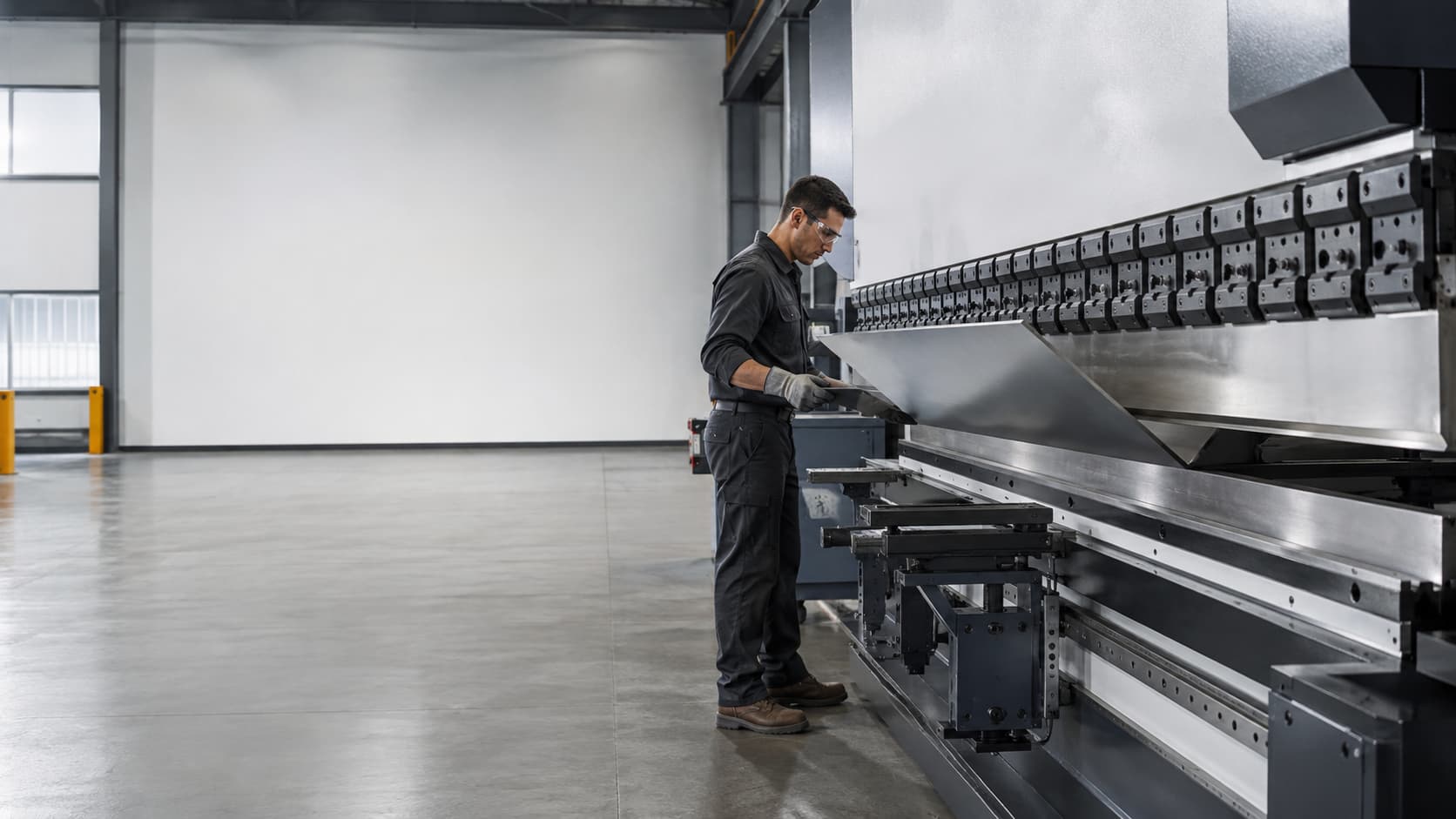
Metal Bending & Press Brake Forming in Vancouver
Precision press brake work on sheet and plate — panels, brackets, channels and custom profiles.
Bending is what turns flat stock into a part. Our press brake forms sheet and plate to your angles and tolerances, whether that is a simple flashing return, a run of matching brackets or a custom profile that has to sit flush against something already built. Send a drawing, a DXF or a cardboard mock-up — we work from all three.
What we form
Flashings and closures, brackets and angles, channels and hat sections, equipment panels and covers, and custom profiles that have to match something already built. Steel, stainless and aluminum in sheet and light plate.
How to send us a job
A dimensioned sketch is enough. A DXF or STEP file is better. A cardboard mock-up of the profile you want is perfectly acceptable and more common than you would think. Tell us the material and the finish and we will confirm the bend radii and flat pattern before we form anything.
What Forming Actually Changes
Bending replaces a weld. A formed corner is stronger, cleaner and quicker than a mitred and welded one, and on visible work it is the difference between a piece that reads as one object and one that reads as parts joined together.
It also changes cost. A formed part usually costs less in labour than a fabricated equivalent, and more in setup. On one piece, welding often wins; on a run of the same part, forming wins comfortably.
What We Form
- Sheet and plate folds — flanges, returns, boxes, pans, trays and covers.
- Formed corners on frames, panels, treads and enclosures where a welded mitre would show.
- Angles, channels and profiles bent to a required geometry.
- Radius bends and curved sections for railings, screens, planters and architectural work.
- Brackets, gussets, clips and mounting plates.
- Multi-bend parts made to a drawing, in quantity.
Bend Radius, Grain and Springback
Three things decide whether a bend comes out the way it was drawn, and none of them are obvious from a drawing.
Inside radius. Every material has a minimum radius it will take without cracking on the outside of the bend, and it varies with the alloy, the temper and the thickness. A drawing that specifies a sharper radius than the material will accept is a drawing that produces cracked parts.
Grain direction. Bending across the rolling direction is far more forgiving than bending along it. On a part that is close to the limit, grain direction decides whether it cracks.
Springback. Metal relaxes after forming, so the tool has to overbend to land on the target angle. How much depends on the material and the radius, which is why the first part of a run is a test part rather than a finished one.
Aluminum in particular is unforgiving here — some alloys and tempers bend well and some crack at radii that mild steel handles without complaint. Telling us the alloy and temper, not just “aluminum”, changes what we can do with it.
Sending Us a Job
We can work from a drawing, a flat pattern, a sample, or a sketch with dimensions. What we need to know:
- Material, and for aluminum and stainless, the alloy and temper if you know them.
- Thickness.
- The finished dimensions that matter — which faces have to be right, because a bend allowance has to give somewhere.
- Bend angles and any required inside radius.
- Quantity, because it changes the approach entirely.
- Whether the part is visible, and which face is the show face.
- Whether it needs welding, finishing or coating afterwards.
If you have a flat pattern already, tell us who generated it and to what bend allowance. Patterns developed for a different machine and tooling frequently do not land where they were meant to, and it is cheaper to redevelop the pattern than to scrap the parts.
Tolerances and Show Faces
On a multi-bend part, dimensional error accumulates across the bends. If every dimension is called critical, the part gets expensive; if you tell us which two or three actually matter, we work outward from those and let the tolerance land where it does no harm.
The same applies to appearance. Forming marks the surface on the tooling side. On a visible part, tell us which face shows and we work to keep the marking off it.
Forming as Part of a Bigger Job
Most of our forming is one stage of a fabrication rather than a standalone service — panels for screens and equipment screens, pans and trays for planters, formed corners on enclosures, stringer and tread details on stairs. If your part is heading into an assembly, it is usually cheaper to have the whole assembly made in one place than to have parts formed here and welded elsewhere.
What We Do Not Claim
We do not publish maximum thickness, length or tonnage figures on this page. What a shop can form depends on the machine, the tooling, the material and the geometry together, and a number on a web page is a poor substitute for a real answer. Send the part or the drawing and we will tell you plainly whether we can form it, and where it should go if we cannot.
Get a bending quote
The consultation is free and it happens in person — we measure, check what we are fixing into, and give you a real number. Request a quote or call (778) 805-5333.