
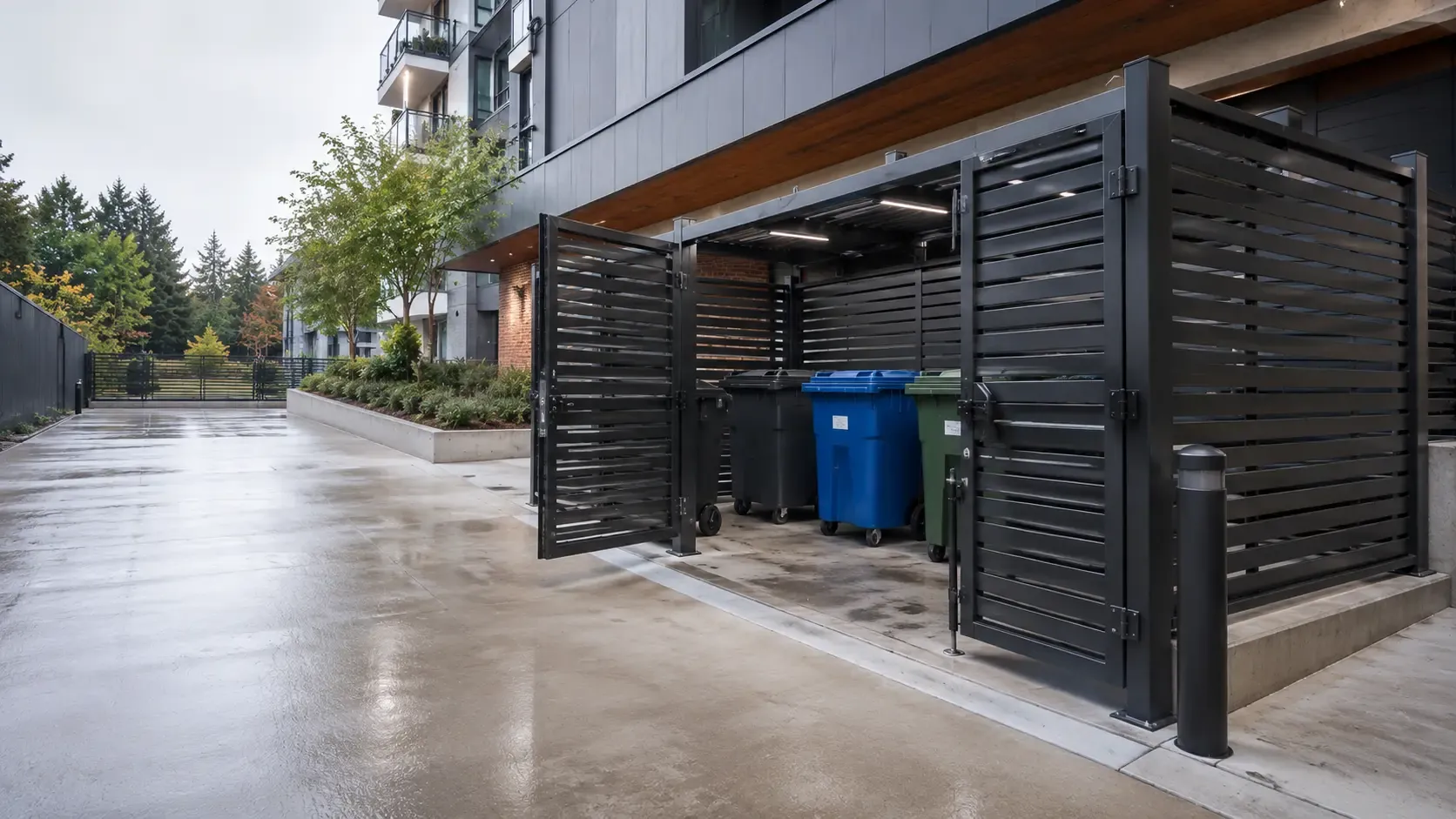
Custom Garbage and Recycling Enclosures
Garbage, recycling and waste enclosures built around the bins a property actually has, on the pad that is actually there.
Most waste enclosures fail for the same reason: the building’s waste changed and the enclosure didn’t. A structure built for two bins is now holding four, the gates no longer close over them, and every collection day something gets left outside.
TrussMetal fabricates garbage, recycling and waste enclosures in North Vancouver — built around the bins a property actually has, on the pad that’s actually there. Not a standard size with your bins pushed into it. (If you know these as dumpster enclosures, that’s the same thing.)
Send a photo of the existing waste area and tell us how many bins you have. That’s enough for us to start.
What Actually Determines the Size
There is no standard enclosure dimension, and any supplier publishing one is describing a product they already build rather than the space you have. Enclosure size is the output of bin footprint, how many streams the building separates, how bins get moved in and out, how the truck collects, and what the existing pad allows.
So instead of a size chart, here is what has to be established before anything can be drawn.
| Waste setup | What must be measured | Gate and access consideration | Collection consideration | What we need from you |
|---|---|---|---|---|
| Single commercial bin | Bin footprint including lid swing and wheels; pad size; clearance to the building and to parking | Whether the bin is wheeled out or the truck reaches in; how far a gate can swing before it hits something | Whether it’s a front-load, rear-load or bin-swap service — each needs different approach room | Photo of the bin with the label visible, photo of the pad, and who your hauler is |
| Multiple bins, one stream | Combined footprint plus the gap needed to move the inside bin past the outside one | Double leaf almost always; whether both leaves need to open every time | Whether all bins are pulled every collection or only some | Bin count, sizes, and whether staff or the hauler moves them |
| Garbage plus recycling | Both bin types — recycling bins are frequently a different height and lid style | Whether users need to reach one stream without opening the whole enclosure | Different haulers on different days is common, and each may need its own access | Which streams, which containers, and whether the same company collects everything |
| Organics, garbage and recycling | Three or more footprints; organics containers are often smaller but need the most frequent access | A dedicated pedestrian leaf or a smaller access door is often the difference between the system being used and being ignored | Organics collection frequency is usually higher, and odour management matters more | Whether organics separation is required for your property — this varies by municipality and property type and should be confirmed |
| Existing concrete pad retrofit | Pad dimensions, condition, slope and drainage direction; where the old posts were fixed | Whether the new enclosure can use the existing footprint or has to extend past it | Whether the truck’s existing approach still works if the footprint changes | Photos of the pad including the base of the old posts, and a note on whether the pad drains or ponds |
| Strata enclosure | Everything above, plus the route residents take to reach it | Self-closing and one-handed operation matter — residents arrive carrying a bag | Whether the enclosure sits on common property and who is responsible for maintaining it | Bin count, resident route, and whether this is a depreciation report item |
| Restaurant enclosure | Bin footprint plus grease, cardboard and glass containers, which are frequently forgotten at design stage | Heavier use, more frequent opening, and hardware that will be operated dozens of times a day | Higher collection frequency, and often more than one hauler | Every container type on site — including the ones that currently live outside the enclosure |
Where a project has drawings or a waste management plan, we build to them. Where it doesn’t, the fastest route is photographs and a bin count.
Enclosure Types
The same structure serves very different jobs. Strata and multi-family enclosures are the highest-use case and the one most often replaced rather than built new — they have to work for residents daily, a hauler weekly, and a council that has to approve the cost, and appearance matters because people look at it from their windows. Commercial and mixed-use enclosures are mostly about screening and containment, and about not becoming somewhere people leave things. Restaurant and food service is the hardest environment on this product: high frequency, heavier loads, liquid waste, grease and cardboard, and hardware operated dozens of times a day — gates and latches fail here first. Multi-stream recycling is driven by separation rather than volume, where the design problem is reaching a small organics bin without opening a large gate. Retrofit and replacement and wildlife-resistant configurations are covered in full below, because both come up more than everything else combined.
Gates
Gates are where enclosures fail, and it is almost always a hardware or geometry problem rather than a fabrication one.
Single leaf suits narrow openings and pedestrian-only access. Simple, fewer failure points, but the leaf gets heavy quickly as the opening widens, which is what causes sag.
Double leaf is the default on anything a bin passes through. Halves the leaf weight and the swing radius. Needs a drop bolt or cane bolt to hold the inactive leaf, and a positive stop so the active leaf can’t be pushed past its hinges.
Sliding is worth considering where there is no room to swing — a tight lane, a parking aisle, or a gate that would otherwise open across a walkway. It trades swing space for track and running clearance, and the track has to stay clear of debris to keep working.
What gets decided along with the leaf configuration:
- Clear opening. Measured after the frame, hinges and any stops — not the rough opening. This is the single most common measurement error, and the one that means a bin doesn’t fit through a gate that looks wide enough.
- Swing conflict. Where the leaf goes when it’s open, and what it hits — a parked car, a curb, a downspout, another gate, or a slope that stops it opening fully.
- Hold-open. Gates that won’t stay open get propped with a bin, which bends them. A cane bolt into a ground socket, or a hold-back catch, solves it cheaply.
- Self-closing. Appropriate where the enclosure must not be left open — wildlife exposure, odour, or wind. Closers add maintenance and need to be matched to leaf weight, so they’re a decision rather than a default.
- Latch selection. Has to work one-handed for a resident with a bag, survive daily use, and — where wildlife is a concern — resist being worked open. Latch and gate alignment have to stay matched, which is why sag and latch failure are the same problem.
- Hinge durability. The hinge carries every load the gate will ever see. Heavy-duty barrel or bolt-on hinges, with the ability to adjust or replace without cutting the frame apart, are what make an enclosure last past its hardware.
- Vehicle interaction. Where the enclosure sits on a drive aisle or beside a loading area, the gate and its posts are in the path of something that will eventually hit them.
We also fabricate and repair gates generally, and fit gate hardware including closers, latches and drop bolts.
Infill
The frame does the work; the infill decides how the enclosure looks and behaves. Each option trades the same handful of properties against each other.
| Infill | Behaves like | Trade-off |
|---|---|---|
| Steel slat | Good screening with airflow between slats; the most common choice; slat spacing tunes privacy against ventilation | More pieces to coat and more edges to corrode than sheet |
| Perforated sheet | Clean architectural appearance, even light, good airflow; pattern can be selected for the sightline | Costs more; holes can trap debris and are harder to wash down |
| Expanded metal | Strong, economical, high airflow, difficult to climb | Utilitarian appearance; poor visual screening unless a heavier pattern is used |
| Welded mesh | Strong and see-through; useful where visibility into the enclosure is wanted for security | Almost no screening or odour containment |
| Solid sheet | Maximum privacy and the best odour containment | Heaviest, acts as a wind sail, retains heat and moisture inside, and shows dents permanently |
| Wood or composite on a steel frame | Warmest appearance; often specified to match a building’s cladding | Boards need replacing periodically; the fixing detail decides whether that’s a ten-minute job or a rebuild |
The properties worth balancing deliberately: privacy against airflow, because a fully sealed enclosure holds odour and moisture; weight against wind, because a solid infill turns the whole enclosure into a sail and puts that load into the posts; visibility against security, since seeing in deters dumping but also displays the bins; and maintenance, because whatever can’t be washed down won’t be. Where wildlife access matters, gaps and climbing purchase matter more than the material itself.
Materials and Corrosion
Waste enclosures see conditions most outdoor metalwork doesn’t: standing liquid, organic acids, repeated impact from bins, and constant wetting at the bottom edge.
Steel is the structural default — strongest per dollar, repairable, and it takes the impact a bin corral receives. Unprotected it corrodes, so the coating system is not optional on this product. Hot-dip galvanizing is the baseline for exposed steel and coats inside hollow sections, which matters on posts standing in a wet pad. Powder coating over galvanizing — a duplex system — gives a specified colour with considerably better life than coating alone. Aluminum appears in infill and lightweight panels; it doesn’t rust, but it’s softer and needs isolating where it meets steel. Wood or composite on a steel frame keeps the structure in metal and the appearance in something warmer.
Galvanizing and coating are carried out by specialist applicators. The value in coordinating them with fabrication is that the coating system gets matched to the material, the exposure and the intended appearance before anything is built, rather than chosen afterwards from what’s available.
What actually causes enclosures to fail early:
- Trapped moisture. Closed sections with no drainage, and hollow posts open at the top. Water gets in and never leaves.
- Waste liquids. Leachate is more aggressive than rain, and it collects at the bottom edge of every panel and post.
- Bottom-edge corrosion. The base of the enclosure sits in whatever pools on the pad. If the pad drains toward the enclosure, that’s where it will fail first regardless of specification.
- Coating damage. Bins hit the inside faces daily. Damaged coating that is never touched up starts corrosion from the inside out, where nobody is looking.
- Dissimilar materials. Aluminum against steel, stainless fasteners into galvanized, and metal in contact with permanently wet concrete or timber all need isolating.
Material notes by application: steel, aluminum, wood and metal.
Cleaning and Drainage
An enclosure that can’t be cleaned becomes the problem it was built to solve. Two things make it possible: access, and knowing where the water goes.
Access means room to get a hose and a broom around the bins without moving all of them — which is a layout decision, not a plumbing one. It also means infill and framing that can be washed down rather than horizontal ledges that collect what the wash-down loosens.
Drainage is largely a property of the existing pad. If it slopes toward the building or ponds in a corner, an enclosure will not fix that, and it’s worth knowing before the design is fixed. Where wash-down water needs to go somewhere specific, or where a drain is involved, that belongs to the appropriate trade or consultant — we’ll flag it, we won’t design it.
Retrofit and Replacement
Most enclosure work is replacing something that already exists. The useful first question is almost never “what should we build” — it’s “what part of this actually failed”.
Gates sagging
The most common single complaint. A leaf drops, stops latching, drags on the pad and gets forced. Often the frame is sound and the fix is hinges, a stiffener and a drop bolt rather than a new enclosure. Worth checking before anyone quotes a replacement.
Hinge and latch failure
Under-specified hardware on a high-use enclosure. Upgrading the hardware and correcting the alignment usually costs a fraction of replacement, and is the highest-return repair on this product.
Rust and bottom-edge deterioration
Where corrosion is confined to the base of posts or the lower panels, sections can often be cut out and replaced rather than the whole structure. Where the post bases have gone, that’s structural and the answer is different.
Damaged panels
Individual panels can be replaced if the infill was detailed to come out. Where it was welded in solid, replacement is more involved — which is an argument for how the new one gets detailed.
Changing bin sizes or added streams
A hauler changes container type, or the building adds organics, and suddenly nothing fits. Sometimes the existing footprint can be extended; sometimes the pad allows a reconfiguration inside the same footprint. Both are cheaper than starting again.
Wildlife access
An existing enclosure can often be improved — closing gaps, upgrading the latch, correcting alignment, addressing climbing purchase. Whether that’s sufficient depends on the enclosure and on how waste is managed, and is covered below.
Vehicle damage
A corner or gate post hit by a truck or a resident’s car. Usually a section repair plus protection so it doesn’t recur.
Pad still good, enclosure finished
The best-case retrofit. Where the concrete pad is sound and drains correctly, a new enclosure can frequently be built on the existing footprint with no concrete work at all — which removes the most disruptive and expensive part of the job.
Protecting the Enclosure From Vehicles
Enclosure corners, gate posts and the approach side take impact from collection trucks and from drivers reversing. Where that keeps happening, bollards at the vulnerable corners are usually cheaper than repeatedly repairing the enclosure. Configuration and mounting depend on the pad and the approach.
Fitting the Building
A waste enclosure is often the only piece of a property nobody designed, and it usually shows. The variables worth deciding rather than defaulting:
- Colour and finish matched to the building’s existing metalwork, cladding or fencing rather than left as galvanized grey by default.
- Infill selected for the sightline — what it looks like from the street, from the units above it, and from the parking area are three different views, and they don’t always want the same answer.
- Roof or no roof. A roof keeps rain out of the bins, helps with odour and wildlife, and hides the contents from above — which matters where units overlook the enclosure. It also adds cost, adds wind load, may affect what the collection truck can reach, and in some cases changes how the structure is treated for approval purposes. Worth deciding early, not late.
- Screening height, which is a sightline question rather than a containment one, and should be set from where people actually look at it.
This is about making the enclosure belong to the building. Standalone privacy and wind screening is separate work.
Wildlife-Resistant Enclosures
We build wildlife-resistant enclosures. We don’t build bear-proof ones, and nobody should tell you they do.
Resistance is a property of the whole enclosure and how it’s used, not of the material it’s made from. A heavy steel enclosure with a gap at the bottom, a latch that can be worked open, or a gate left propped is not resistant to anything. What contributes:
- Latching. A latch that positively engages and cannot be levered or nosed open, and that residents will still actually use.
- Gaps. Between leaves, at the base, at the top, and anywhere infill meets frame. Gaps are the usual point of entry.
- Gate alignment. A sagging gate opens a gap and defeats a latch simultaneously. Alignment is a maintenance item, not a one-time build item.
- Leverage points. Anything that offers purchase — a projecting edge, a loose panel, a handle in the wrong place.
- Maintenance. Hardware that isn’t checked stops working, and an enclosure is only resistant while its hardware is.
- Waste practices. Bags left outside the enclosure, lids left open, or organics put out early defeat any enclosure regardless of how it’s built.
Some municipalities have wildlife attractant or waste storage requirements that affect how bins must be stored, and these differ between jurisdictions. What applies to your property should be confirmed with the municipality with jurisdiction. Where a specification calls for a particular tested or certified container or enclosure, that requirement should be identified early, because it is met by a certified product rather than by custom fabrication.
Who We Build For
Strata corporations and property managers replacing an enclosure that has stopped working. Restaurants and food service operators dealing with high-use failure. General contractors and developers with a waste enclosure drawn into a package. Commercial property owners and building managers where the enclosure has become a dumping ground or an eyesore.
Where We Work
Our shop is at 5128 Francisco Court in North Vancouver. We fabricate and install across Metro Vancouver and the Lower Mainland, including Vancouver, North Vancouver, West Vancouver, Burnaby, Richmond, Coquitlam and Surrey.
Questions We Get Asked
How big does the enclosure need to be?
It depends on your bin footprints, how many streams you separate, how bins are moved in and out, and how the truck collects. Send photographs of the bins with their labels visible and a photo of the pad, and we can work out what fits.
Can you build on our existing concrete pad?
Often, yes — and where the pad is sound and drains correctly, that removes the most disruptive part of the job. What we need to see is the pad’s condition, its slope, and where the old posts were fixed.
Do we lose access to the bins during the work?
That’s a scheduling question rather than a fabrication one. Enclosures are usually fabricated in the shop and installed in a short window on site, and where continuous bin access is required it can be planned around. Tell us your collection days when you enquire.
Can it be made bear-resistant?
It can be configured to reduce wildlife access — latching, gaps, alignment and leverage points all contribute. No enclosure is bear-proof, and resistance depends on maintenance and on how waste is managed as much as on the build. If a certified container or enclosure is required for your property, that should be identified at the outset.
Can it match our building?
Yes. Colour, infill type and screening height can all be selected to suit the building, and the finish can be matched to existing metalwork or cladding.
Our gates sag and won’t latch — do we need a whole new enclosure?
Frequently not. Sagging is usually hinges, leaf stiffness and alignment. Send a photo of the gate closed and one of it open, and we’ll tell you whether it’s a repair or a replacement before quoting either.
Do we need a permit?
It depends on the municipality, the structure and whether a roof is involved. Requirements differ between jurisdictions and should be confirmed with the authority having jurisdiction. We’ll flag what we think may apply.
Send us a photo and a bin count
You don’t need dimensions or a drawing. A photo of the existing waste area, a photo of the bins with their labels visible, and how many you have is enough for us to start.
Email sales@trussmetal.com or call (778) 805-5333. If it needs seeing, we can arrange a site visit and quote against a measured drawing.
Garbage gates and enclosure gates
People ask us for “garbage gates” as often as they ask for enclosures, and they usually mean the same job: the gate leaves on a bin enclosure, or a replacement gate on an enclosure that already exists. The gate is the part that fails, because it is the only part that moves.
We build garbage gates as single or double swing leaves, in steel or aluminum, with infill to match the enclosure — solid panel, perforated sheet, slats or mesh. Where an enclosure has to take a bin cart in and out several times a day, we size the hinges and the posts for that duty rather than for the size of the leaf alone.
Common requests across Metro Vancouver — Vancouver, Burnaby, Richmond, North and West Vancouver — are replacing sagging or damaged gate leaves on an existing enclosure, adding a pedestrian gate beside the bin opening, and fitting gates that hold open so they are not blocking the lane on collection day. If your existing gates are sagging or the hinges have torn out, that is often a gate repair rather than a replacement.
Garbage enclosures for stratas and condominium buildings
Most of the enclosures we build are for strata and condominium properties, and that buyer has a different problem from a single business. The enclosure is used by dozens of residents daily, it has to survive that, and the decision usually goes through a council or a property manager who needs a scope they can actually review and compare.
The practical points that decide whether an enclosure works for a multi-family building, and that get missed surprisingly often:
- Hauler access. The gate opening and the swing have to let the collection contractor actually get carts in and out on collection day, in the space available. This is the most common reason an otherwise good enclosure gets rebuilt — measure it against how your hauler works before anything is fabricated.
- Cart sizes and how many. Garbage, recycling and organics carts differ in footprint, and the mix changes the internal clearance you need. Tell us the carts you actually have rather than the ones the building started with.
- Wildlife. On the North Shore and in the Tri-Cities this is a real design input, not an afterthought. Latching that resists animals, gates that self-close rather than sit propped open, and infill without gaps large enough to reach through.
- Ventilation versus screening. A fully solid enclosure hides the bins and traps odour. Perforated, slatted or partly open infill lets air move while still blocking the sightline. Which is right depends on where the enclosure sits relative to windows and walkways.
- Access control. Where the building wants the enclosure locked, we build to suit the hardware — keyed, coded or fob — and coordinate with whoever supplies it, so the gate and the lock are designed together rather than drilled together later.
- Staged work on an occupied site. Residents still need somewhere to put their garbage while the enclosure is replaced. We plan the sequence so the bin area stays usable.
Requirements for waste enclosures — size, location, screening and access — can be set by the municipality and, for newer buildings, by the development permit, and they differ between Vancouver, Burnaby, Richmond and the North Shore. We raise it early and recommend confirming with the municipality rather than assuming. Our wider multi-family work is on the strata and property management page.
Pricing and Budget
Waste and bin enclosures are quoted per project because the drivers are all site specific: how many bins, how the gates swing, what the pad is, whether wildlife-resistant latching is needed and what the municipality requires.
A word of caution on comparison shopping: the prefabricated residential bin sheds sold online, at roughly $950 to $2,750 in composite or cedar, are a different product entirely from a welded steel commercial enclosure with framed gates and hardware. There is no published Canadian price for the latter, and we will not invent one.
What we price against
- Number and size of bins to be housed
- Gate count, gate width and swing clearance
- Wildlife-resistant or lockable hardware
- Concrete pad or footings, and whether they exist already
- Screening height and any municipal bylaw requirements
- Whether an existing enclosure has to be removed
Send photos and the basics and we will come back with a real budget. See all pricing guides or request a quote.