
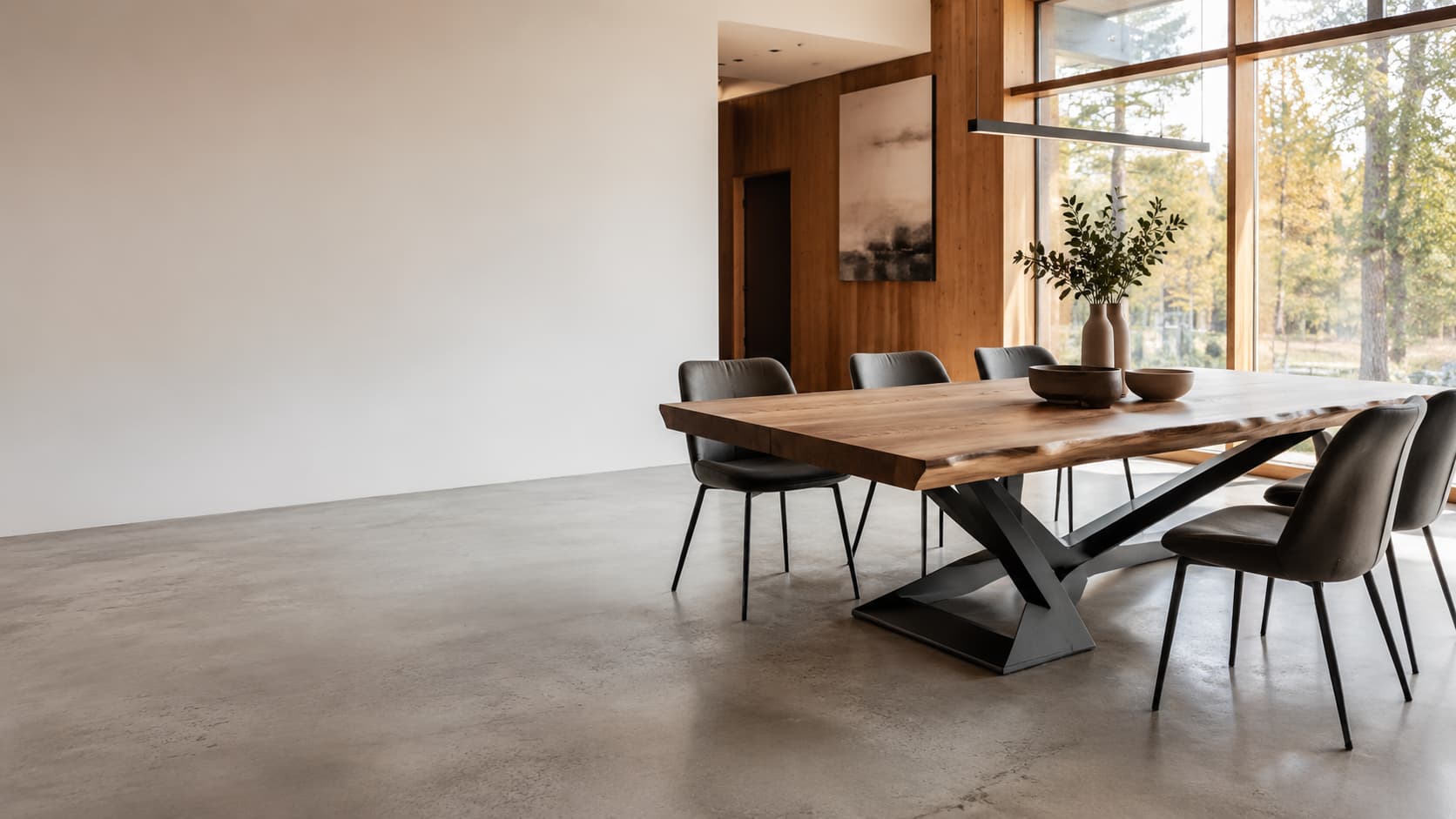
Custom Metal Furniture in Vancouver
Interior tables, benches, shelving, bed frames and desk bases — built to your room, not to a catalogue size.
Furniture is where metalwork stops being structural and starts being something you touch. That changes the details: welds get dressed flush, edges get eased, and the finish has to feel right under a hand rather than just survive the weather. Most of what we build here is a single piece sized to a specific space. Everything on this page is interior work — tables, bases, shelving, storage and seating built for indoor spaces. Outdoor and commercial site seating is a different product, with different materials, finishes and fixings. For heat features outdoors, see our custom fire pit tables and bowls.
Looking for a standard piece you can price and buy today? Shop display pedestals and plinths online.
What we build
Dining and coffee tables, interior benches for entryways and window seats, console and side tables, shelving, bed frames and desk bases. Steel frames on their own, or steel with timber, stone or glass tops that we source and fit for you.
One-off or a run
Most of this work is a single piece built to a room — a table sized to a specific alcove, an interior bench to a window seat. We also build short runs for cafés, restaurants and offices where every piece has to match. Send dimensions and a reference image and we will quote from that. One line is stocked as a repeatable program rather than a one-off: steel display pedestals, in four square top sizes and four heights.
What We Build
Dining and conference table bases
The most common request. A steel base built to carry a specific top — timber, stone, glass or concrete — at a specific height, in a form that leaves legroom where people actually sit. Trestle, pedestal, sled, cantilever or a single sculptural leg. The base is the engineering; the top is the finish.
Full tables
Base and top together, where we source and fit the top as part of the piece. Timber slabs, stone and glass are selected with you and fitted so the top can move as it needs to without the base fighting it.
Console, side and coffee tables
Smaller pieces where proportion carries the whole design and the section sizes are the design decision. These are also the pieces most often built as a set with a larger table.
Shelving and storage frames
Wall-mounted and freestanding shelving, bookcases, media units, bar shelving and open storage frames. Fixing is the constraint here more than the metalwork — what the wall actually is decides what is possible.
Interior benches and window seats
Entry benches, window-seat frames, dining benches and bench frames for upholstery or timber tops. Interior seating, built for a specific room.
Bed frames and headboard frames
Steel bed frames and headboard structures built to a mattress size and a ceiling height, usually as part of a bedroom scheme.
Desk and workstation bases
Desk bases, credenza frames and workstation structures for home offices and small commercial fit-outs.
Custom frames for someone else’s finish
Structures built to carry stone, glass, timber or upholstery supplied by a designer, a millworker or a stone supplier, with the interfaces coordinated in advance.
Bar stools, chairs and counter seating
Steel-framed bar stools, counter stools and chairs, either as a one-off or as a matched set for a kitchen island or a hospitality fit-out. Seats can be left as steel, upholstered by your upholsterer, or made to take a timber seat we or your millworker supply.
Everything on this page is interior. Outdoor and commercial site seating — plaza, park, courtyard and campus benches — is a different product with different materials, finishes and fixings, and it belongs on custom benches and site seating. Fireplace surrounds and architectural wall metalwork belong on fireplace surrounds.
Custom metal tables and table bases
Tables are the piece we are asked for most. A custom metal table solves a problem an off-the-shelf one cannot: a room that needs a specific length, a base that has to clear a bench seat, a top you already own, or a leg position that stops people knocking their knees.
If you would rather choose a ready-made leg or pedestal base than have one drawn from scratch, our table leg and base catalogue lists 233 references with the manufacturer’s published dimensions — we still build the top and do the welding and finishing.
We build the base, the full table, or a frame designed around a top supplied by someone else. Common requests are dining tables, conference and boardroom tables, console and coffee tables, and restaurant and cafe tables where the same base has to be repeated across a room.
What we need from you to price one is the finished size, the height, the top material and thickness if it is already decided, and a reference image or sketch of the look you are after. If the top is stone or solid timber, tell us early — the weight and the way it moves change how the base has to be built.
Working From a Designer’s Drawing
A large share of this work arrives as a drawing from an interior designer or an architect, often as an elevation and a plan with the intent clear and the connections unresolved. That is normal and it is the right stage to involve us.
What we resolve at that point: section sizes that hold the proportion without looking heavy, how the top attaches and whether it can move, where welds fall relative to the show faces, how the piece comes apart if it has to get into the room, and what the finish sequence has to be. Bringing us in while the drawing is still moving costs nothing and usually improves the piece.
Send whatever you have. A dimensioned sketch, a rendering, a photograph of something similar with notes, or a napkin drawing with three measurements all work as a starting point.
Finishes for Metal Furniture
Furniture is touched constantly and looked at closely, so the finish matters more here than on almost anything else we build.
- Blackened steel — the finish behind most of the dark table bases and shelving people send us photographs of. It lightens at the edges over years, which reads as use rather than as wear.
- Raw steel, waxed or clear-coated — mill scale left visible. The most honest finish there is, and the one that shows fingerprints.
- Powder coat — when the piece needs to be a colour, or to stay exactly as delivered for a decade.
- Solid brass or bronze — on legs, frames and trim where the metal is the point.
Outdoor furniture is a different brief entirely: powder coat over galvanized steel, or 316 stainless. Nothing else lasts on a patio here. See metal finishes.
Show Faces, Welds and Why Furniture Is Harder Than It Looks
Structural metalwork can be welded and moved on. Furniture cannot. A weld on a table base is at eye level, at arm’s reach, under a lamp, and it will be touched.
What that changes: welds get dressed flush and blended rather than simply ground, edges are eased so they do not catch a hand or a sleeve, the sequence is planned so heat distortion does not pull a frame out of square, and the show faces are identified before anything is cut so the marked side ends up where nobody sees it.
It is also why furniture takes longer per kilogram than almost anything else we build, and why a cheap version looks cheap from across the room.
Tops, Fixings and Movement
Timber moves. A solid timber top fixed rigidly to a steel frame will either cup, split or pull its fixings out — usually within the first heating season. Slotted fixings, buttons or Z-clips let the top move across its width while staying located, and that detail is the difference between a table that survives and one that opens a gap.
Stone needs support across its span rather than at the corners, and it needs handling and setting-out that suits its weight. Glass needs the right support pads and edges detailed so nothing bears on a point.
Floors matter too. Steel feet on hardwood, tile or a finished concrete floor need pads or levellers, both to protect the floor and to deal with a floor that is not flat — and almost none are.
One Piece or a Short Run
Most of this work is a single piece sized to a specific space. We also build short matching runs for cafés, restaurants, offices and hospitality fit-outs where every piece has to be the same.
A run changes the approach rather than just the quantity. Jigs get made, the finish moves from blackening toward powder coating for repeatability, and the first piece becomes a prototype that gets approved before the rest are built. That prototype step is worth the time on any run above a handful of pieces.
Getting It Into the Room
A dining table base that will not go up a staircase is a real and recurring problem. Where a piece cannot arrive assembled, it is designed to come apart at planned joints — bolted connections that land where they are not seen, or a top that fits separately.
That is a design decision, not a site decision. Tell us about the stairs, the door widths, the corners and the lift before the piece is built.
Who We Build For
Interior designers with a piece drawn to a specific proportion and finish. Homeowners who need something the right size for a room rather than the nearest catalogue size. Architects with joinery and furniture in a scheme. Restaurants, cafés and hospitality operators needing matching pieces that survive commercial use. Home builders and renovation contractors with built-in furniture in a scope.
Questions We Get Asked
Can you build to our exact dimensions?
That is the whole point of the page. Dimensions come from the room rather than from a size chart, and a table sized to an alcove is the most common thing we make.
Do you supply the top?
We can source and fit timber, stone and glass tops, or build the base to carry a top you are supplying. If someone else is supplying it, we need its dimensions, thickness and weight before we build the base.
Will a blackened finish look the same on every piece?
No, and that is the character of it. For a matching set where consistency matters more than character, powder coating is the better choice and we will say so.
Can it be taken apart to get it into the room?
Yes, where it needs to be. Tell us about the access before fabrication and we design the joints to fall where they will not be seen.
Will a steel base mark our floor?
Not if it has pads or levellers, which we fit as standard on anything going onto a finished floor. Levellers also deal with the floor not being flat, which is more common than people expect.
Can you match a piece we already have?
Usually in profile and proportion. Finish is the honest limitation — a new blackened piece beside one that has been handled for five years will not look identical at first.
Send dimensions and a reference image
The room dimension that matters, the height you want, and a photograph or a drawing of the look you are after is enough to start. If a designer is involved, send their drawing and we will work from it. The consultation is free and in person.
Get a price on your piece
The consultation is free and it happens in person — we measure, check what we are fixing into, and give you a real number. Request a quote or call (778) 805-5333.