
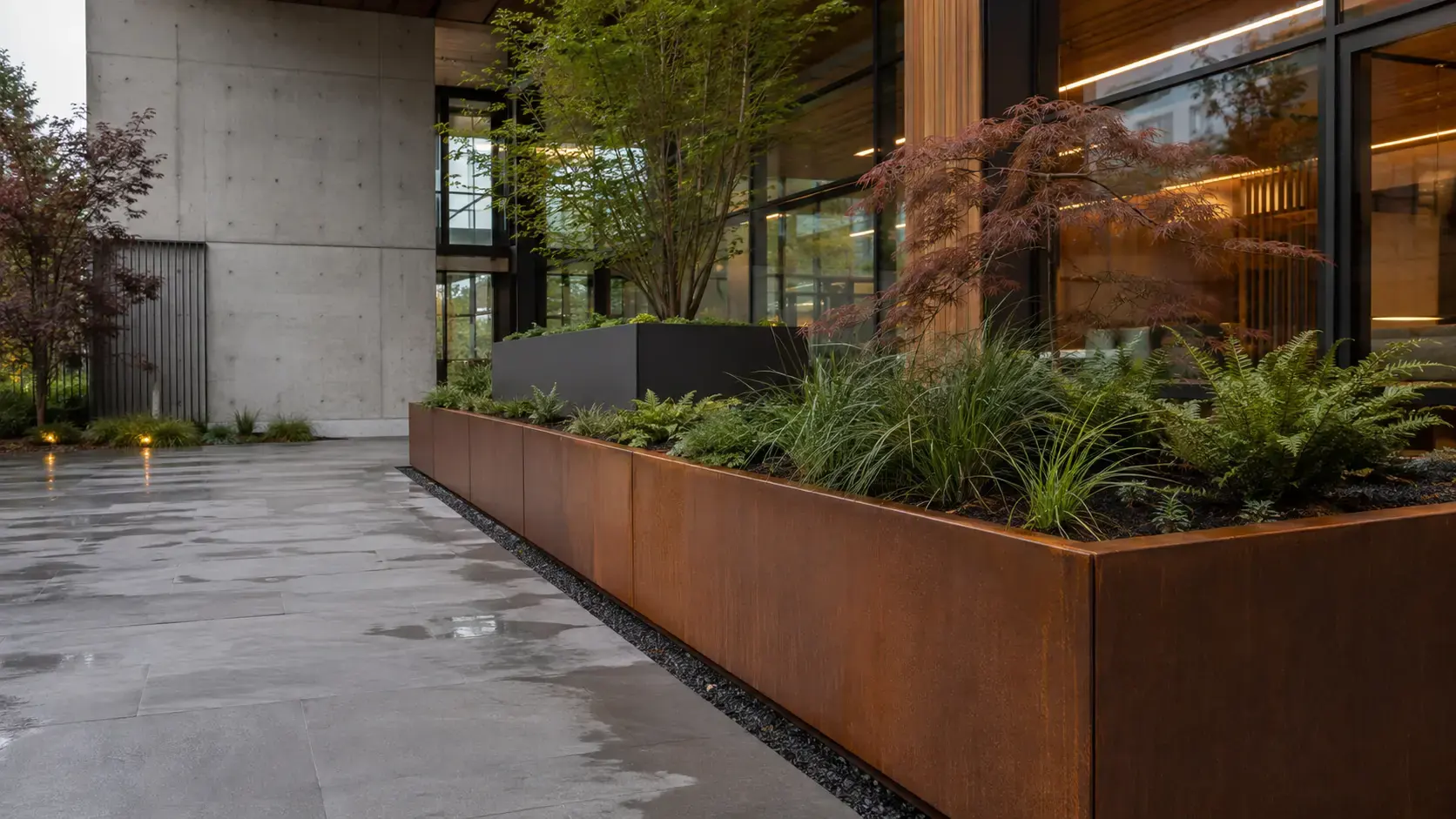
Custom Steel and Corten Planters
Planters in steel, weathering steel, aluminum and stainless, built to the dimensions on your drawing rather than rounded to the nearest stock unit.
Sold online
Standard Corten Sizes
Twelve standard weathering-steel (Corten) planters — cubes from 300 mm, tall planters, troughs, rectangular and landscape planters and a raised garden bed — are priced and sold online, each made to order in our North Vancouver shop and ready for pickup within 20 business days of payment. Browse the standard Corten planters collection for sizes and prices. Everything below is custom work: built to your drawing or your dimensions and quoted per project.
Catalogue planters come in the sizes the catalogue offers. Sites don’t. A planter that has to close a paving run, follow a curve, fit between two columns, or match something built eight years ago is a fabrication problem, not a procurement one.
Looking for a standard size you can price and buy today? Shop Corten planters online.
TrussMetal fabricates planters in North Vancouver in steel, weathering steel, aluminum and stainless — built to the dimensions on your drawing rather than rounded to the nearest stock unit.
Send us your drawing or your dimensions. A sketch with the overall size and a note on where it’s going is enough to start.
Planter Types
Rectangular and square planters are the workhorse: freestanding, in runs, or built into a wall or seating line. Trough planters — long and narrow — suit edges, balconies and the gaps between columns where nothing standard fits. Divider planters do two jobs at once, separating a patio from a walkway or defining a queue line while still reading as landscape rather than barrier. Tapered planters lighten the form and change how a run reads down a slope. Architectural forms — curved, faceted, stepped, or a profile drawn specifically for the project — are where custom fabrication earns its place, because there is nothing to specify against. Raised beds are the same construction serving a growing function rather than a decorative one, usually with more soil depth and more attention to liner and drainage. Rooftop and amenity-deck planters are a category of their own and are covered separately below. Barrier and perimeter configurations use planters to define an edge — a patio boundary, a plaza perimeter, a pedestrian separation. Where the intent is genuinely to resist vehicle impact rather than to define an edge, that is a different requirement and should be identified as such.
What Decides the Design
We don’t publish a table mapping planter length to steel thickness. Those relationships depend on the form, the soil load, the fixing, the support arrangement and any applicable design requirements — a single chart would be right for the planters that produced it and wrong for most others.
What is genuinely useful is knowing which variables move the design, and what we need from you to resolve each one.
| Design variable | Why it matters | What changes | What we need to know |
|---|---|---|---|
| Overall length | Long unsupported faces are where planters bow outward under soil pressure and where welds telegraph | Material thickness, internal stiffening, whether the run is made as one piece or several | The length you actually need, and whether a joint in the run is acceptable |
| Overall height | Height drives the lateral pressure on the walls and changes how the base has to be supported | Wall stiffening, base construction, and whether a false bottom is worthwhile | Finished height above the surface, and the surface it sits on |
| Soil depth | The plants set the depth; the depth sets the load. Full-depth soil in a tall planter is heavy and often unnecessary | Whether a false bottom is used, and the weight the base and the surface below must carry | The planting scheme or the soil depth the landscape design requires |
| Material | Appearance, corrosion behaviour, weight and cost all move together | Thickness, finish, fabrication approach, staining risk on adjacent surfaces | Preferred material, or the appearance you’re after if the material is open |
| Rooftop or podium location | Loads, membranes and access constraints all apply, and none of them apply on grade | Weight, base detail, membrane protection, drainage route, how it gets to the roof | Whether it’s on structure, and who is confirming what the structure can carry |
| Drainage | Trapped water is the most common cause of early planter failure and of stained hardscape below | Openings, their position, whether water is released or collected, base detail | Where the water is expected to go once it leaves the planter |
| Liner | Separates soil and moisture from the metal, and changes internal dimensions | Whether one is used, and how it’s retained and drained | Whether a liner is specified, and by whom |
| Irrigation | Supply and drainage penetrations have to exist before fabrication, not be drilled later | Penetration locations, sleeves, and how they’re sealed | Whether the planter is irrigated and who is designing that system |
| Stiffening | The difference between a flat face and a bowed one on anything long or tall | Internal ribs, folded edges, rolled top rails, sub-frames | Nothing — this is ours to resolve, but it’s what the price reflects |
| Lifting and access | A planter that can’t reach its position has to be split, and where it splits is a design decision | Number of sections, joint detail, whether it’s assembled on site | The route from the truck to the final position, including any stairs, lifts or gates |
| Finish | Sets appearance and corrosion life, and has to suit the exposure | Coating system, sample requirements, lead time in the programme | Colour or finish if specified, and how close it is to salt air |
| Adjacent paving | What sits below the planter decides whether staining and run-off are a problem | Base detail, drainage direction, material choice — particularly for weathering steel | What the planter stands on and what’s immediately downhill of it |
Where a project has drawings we build to them. Where a piece needs engineered design or sealed documentation — anything load-bearing, anything on structure where capacity is in question — that should be provided or reviewed by the appropriate qualified professional, and we’ll say when we think it applies.
Weathering Steel
Weathering steel — Corten is the name most people use — is specified for its appearance, and it behaves differently from every other finish on this list. The things worth understanding before it goes on a drawing:
The appearance changes, and keeps changing. A new panel, a six-month-old panel and a five-year-old panel are not the same colour. Clients who approve a sample of freshly weathered material sometimes react badly to the same material a year later, which is why a sample at a realistic stage is worth more than a fresh one.
It runs off, particularly early. During the first period of weathering, rain carries oxide off the surface and onto whatever is below. Light concrete, pale paving, stone, a pool edge or a light-coloured wall will stain. That staining is often permanent in appearance terms even when it can be cleaned, and it is the single most common complaint about weathering steel on commercial sites.
Placement is the mitigation. Where the run-off goes is a design decision. A drip edge, a standoff at the base, a gravel or dark-paving strip below, or simply not placing weathering steel directly above a light hardscape all work. Deciding this at design stage costs nothing; discovering it after handover costs a cleaning contract.
Drainage interacts with it. Water leaving the planter carries oxide with it, so where the drainage openings are placed changes where the staining appears.
It is not maintenance-free, and it is not appropriate everywhere. Persistently wet conditions, standing water and constant salt exposure behave differently from the wetting-and-drying cycle the material relies on.
The metallurgy, the alloy behaviour and the exposure conditions are covered in more depth on our weathering steel material page — this section is about what it means for a planter specifically.
Drainage, Liners and Irrigation
More planters fail from water management than from anything structural.
Drainage openings have to exist, and their position matters as much as their presence. Openings in the base release water into whatever is below; openings in the sides above a false bottom release it clear of the surface the planter stands on. Which is right depends on where the water is supposed to go — which is a site question, not a planter question.
Liners separate soil and constant moisture from the metal, and are worth specifying on anything intended to last. A liner changes the internal dimensions, so it has to be decided before fabrication rather than added after. How the liner is retained and how it drains matter as much as whether one is used.
False bottoms reduce soil volume and weight where full depth isn’t needed, create a drainage void, and lift the growing medium clear of the base. On a tall planter with shallow-rooted planting they’re usually the right answer.
Irrigation coordination means the penetrations are made where they’re needed, sleeved and sealed, before the planter is finished. Retrofitting a supply line through a coated planter is avoidable work.
Trapped water is what kills planters — inside closed sections, in the void between a liner and the wall, and at the base where the planter meets the surface. A planter detailed to drain and to stand clear of standing water outlasts one specified with a better coating.
Planting scheme, soil specification and irrigation design belong to the landscape architect or the irrigation designer. We fabricate to what they specify and flag conflicts we can see.
Rooftop and Amenity-Deck Planters
A planter is not suitable for a roof because of what it’s made from. Rooftop and podium installations bring a set of constraints that don’t exist on grade, and each of them belongs to somebody:
- Structural load. A planted, irrigated planter is heavy, and the weight is concentrated. What the structure can carry — and where — is a question for the appropriate qualified professional, and it should be answered before size and soil depth are fixed.
- Waterproofing and membrane protection. Anything sitting on a membrane has to protect it. That affects the base detail, whether the planter stands on pedestals or a slip sheet, and whether it can be fixed down at all.
- Drainage. Water leaving the planter has to reach the roof drainage system without pooling on the membrane or staining the deck surface.
- Access and lifting. How the planter reaches the roof — crane, elevator, stair — usually decides its maximum section size before any design consideration does.
- Wind. Exposure at height is different from exposure at grade, and it affects both the planter and what’s planted in it.
- Maintenance access. Somebody has to reach it to plant, water and replace, and on a roof that’s rarely as simple as it looks in plan.
We fabricate rooftop planters to a design that accounts for these. We don’t confirm that a roof can carry them — where structural confirmation is required, it belongs to the appropriate qualified professional.
Finishes for Planters
A planter is permanently wet on the inside and exposed on the outside, which is a harder brief than almost anything else we make.
- Corten weathering steel — the obvious choice, because the patina is the protection and there is no coating to fail. Design for the first-year run-off staining whatever sits beneath.
- Hot-dip galvanized, then powder coated — when the planter has to be a specific colour. The galvanizing matters more here than almost anywhere, because the inside face stays damp.
- 316 stainless — bead-blasted or brushed, for rooftop and waterfront work where nothing else will hold up.
- Copper with a verdigris patina — for a feature planter. It keeps developing for years and eventually settles into a stable green.
Whatever the finish, the inside gets a separate liner or coating and drainage is designed in, because a planter that holds water kills the plant and the metal together. Full comparison on metal finishes.
Who We Build For
Landscape architects and designers with a planter drawn to a dimension nobody stocks. Developers on amenity decks and podium landscapes. Restaurants defining a patio edge. Commercial property owners and strata corporations replacing timber boxes that have rotted, or matching a phase built years earlier.
Where We Work
Our shop is at 5128 Francisco Court in North Vancouver. We fabricate and install across Metro Vancouver and the Lower Mainland, including Vancouver, North Vancouver, Burnaby and Richmond.
Questions We Get Asked
Can you build a planter to an exact size?
Yes — that’s the reason to fabricate rather than buy. Send the dimensions you need. If the run is long enough that a joint becomes sensible, we’ll tell you where we’d put it and why.
Will a Corten planter stain the paving underneath it?
It can, particularly during early weathering, and light-coloured concrete and stone show it most. It’s a placement and detailing question — a drip edge, a base standoff, or a darker strip below all reduce it. Worth resolving on the drawing rather than after installation.
Do metal planters need drainage?
Yes, and where the openings are placed matters as much as having them, because it decides where the water goes when it leaves. A liner and a false bottom are usually worth specifying alongside.
Can these go on a roof or an amenity deck?
They can be built for it, and the fabrication accounts for membrane protection, drainage and lifting. What the structure can carry is a separate question that belongs to the appropriate qualified professional, and it should be settled before the size and soil depth are fixed.
How thick will the metal be?
It depends on the length, height, soil depth, support arrangement and any applicable design requirements — which is why we don’t publish a chart. Tell us the size and where it’s going and we’ll tell you what we’d build it from.
Can you match planters already on site?
Usually. Send photographs, whatever dimensions you can take, and a note on the finish. Matching a discontinued or original unit is a fabrication problem, which is what a custom shop is for.
Send us your drawing or your dimensions
A plan, a section, a sketch, or just the overall size and where it’s going — any of those is enough to start. If the design isn’t resolved yet, that’s the better time to send it.
Email sales@trussmetal.com or call (778) 805-5333. Ask about material and finish options, or request a finish sample on the actual profile before you commit a run.
Custom and commercial planters
Alongside our standard Corten sizes we build custom planters to a drawing or a dimension — a length that fits a specific terrace, a radius that follows a curved wall, a depth set by what is being planted, or a planter that doubles as a bench edge or a barrier.
Commercial planters are a large part of this work: lobby and courtyard planters, streetfront and patio planters for restaurants, rooftop and amenity-deck planters for stratas, and repeated runs where the same unit is made a dozen times over so they match. For those we build to a fixed detail so a replacement years later still looks like the rest.
Practical points we sort out before fabricating: drainage and whether the planter sits on a membrane, liner or no liner, weight once filled, and whether it has to be moved after planting. Tell us the finished size, where it is going and what is going in it, and we will tell you how it should be built.