
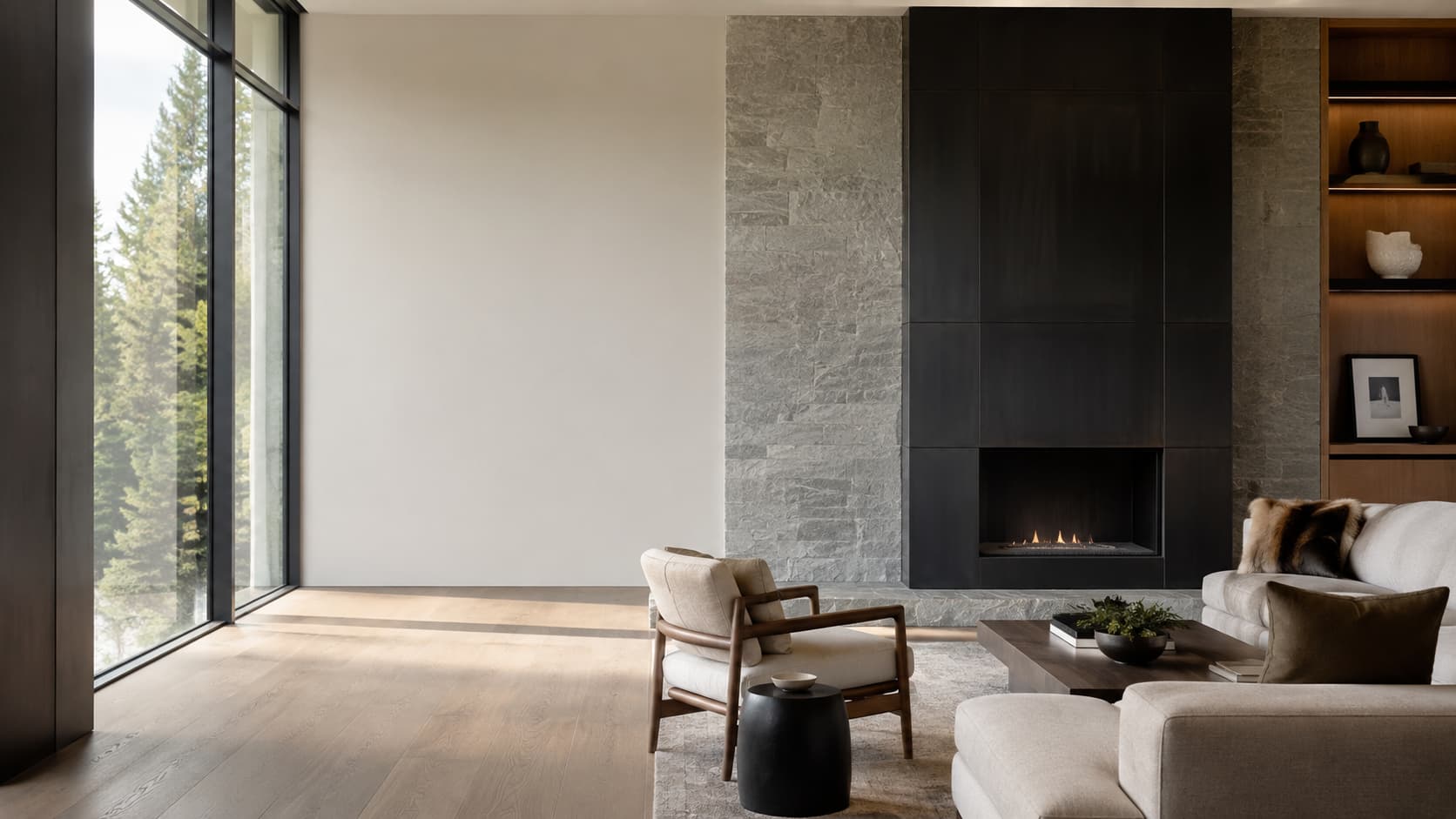
Metal Fireplace Surrounds
Surrounds, hearth plates and mantel shelves in blackened steel, brass and hot-rolled finishes.
A fireplace surround is a small piece of metal doing a lot of work — it frames the focal point of the room and it lives next to a heat source. We build to your firebox model and its clearance requirements, and we choose finishes that hold their colour where things get hot. For outdoor settings, we build the same steel into custom fire pits — tables, bowls and sculptural fire spheres.
What we build
Surrounds, hearth plates and mantel shelves in blackened steel, hot-rolled steel with a clear coat, brass, or powder-coated finishes. Built to wrap an existing firebox or specified alongside a new one during construction.
Heat and clearance
Every firebox has a manufacturer clearance to combustibles, and the surround has to respect it. We work from your fireplace model number and detail the standoffs and fixings accordingly. Finishes are chosen for heat stability — a standard powder coat will discolour where it gets hot, so we do not use one there.
Surround Types
Flat face surrounds
A single plane of metal around the firebox opening, sitting proud of or flush with the surrounding wall finish. The simplest form and the one where the seams, the reveal at the edges and the flatness of the panel are the entire job — there is nothing else for the eye to look at.
Wrapped surrounds with returns
The face plus returns into the opening, so the metal continues around the corner rather than stopping at the drywall. Returns are what stop a surround looking like a sheet stuck to a wall, and they are the detail most often left out of a budget version.
Full-height feature cladding
Metal running from hearth to ceiling, or wall to wall, with the fireplace as one element in a larger clad face. Panel layout becomes the design decision here — where the joints fall, whether they are expressed or hidden, and how the sheet meets the ceiling and the adjacent walls.
Trim frames and reveals
A slim frame defining the opening against stone, tile or plaster. Less metal, and more dependent on the tolerance of whatever it meets, because a narrow frame has nowhere to hide a gap that varies.
Hearth-adjacent metalwork
Hearth plates, raised hearth edging, log storage recesses, and the brackets and frames behind a floating mantel shelf.
Mantel shelves and brackets
Steel shelves, concealed brackets and support frames for timber or stone mantels, coordinated with whoever is supplying the shelf itself.
Furniture — tables, shelving, bases and interior benches — is a different product and belongs on custom interior metal furniture.
Blackened Steel and What It Actually Looks Like
Blackened steel is the most requested finish for this work, and it is worth being honest about what it is. It is a chemical or heat-induced surface colour on the steel itself rather than a coating applied over it, which is why it reads as metal rather than as paint. It varies. Panel to panel, and across a single panel, the tone shifts with the mill finish underneath, the handling and the sealing.
That variation is the reason people choose it and the reason some people are disappointed by it. If you want a uniform, repeatable, identical black across every panel, a powder coat or a painted finish will do that and blackened steel will not. We will show you samples on the real material before anything is fabricated, and we would rather have that conversation early than after installation.
Blackened surfaces are also sealed — with wax, oil or a clear coat — and the sealer affects sheen and how the surface ages with handling. A wax finish near a heat source is a different proposition from one on a console table, which is a coordination question rather than a preference.
Materials
Hot-rolled and mild steel is the default, with its mill surface either kept as the finish or worked back. Stainless where a brushed or satin metal look is wanted and where fingerprints and cleaning matter. Brass for warmth and for a surface that will develop its own patina, which again is a feature or a problem depending on expectation. Powder-coated steel where an exact, uniform, repeatable colour is the requirement.
Seams, Panel Layout and Flatness
Two things decide whether a metal fireplace surround looks expensive: where the joints fall, and whether the panels are flat.
Panel layout is a design decision made before fabrication. Large single panels look cleanest and are limited by sheet size, by what can be carried into the room, and by how the material behaves. Where joints are unavoidable they can be expressed as a deliberate reveal or closed as tightly as the material allows, and choosing which is better done on a drawing than on site.
Flatness is the harder problem. Thin sheet over a large flat area shows every imperfection under raking light, and welding heat moves metal. That is managed through material thickness, stiffening on the back, and a fabrication sequence that controls distortion — and it is a genuine reason a good surround costs more than a bad one.
Heat, Clearances and What We Do Not Determine
This is the part that matters most and it is not ours to decide.
Every fireplace appliance — gas insert, wood-burning unit, electric, or a masonry firebox — has clearance requirements set by its manufacturer for combustible and non-combustible materials around the opening. Those requirements, together with the applicable building requirements confirmed for your project and anything your installer or the authority having jurisdiction determines, govern what may be placed where, and how close.
We do not determine clearances, we do not certify a surround as compliant with them, and we will not work from a figure someone remembers. What we do is fabricate the surround to the confirmed conditions, and coordinate with your fireplace installer, your builder and your designer so the metalwork suits what the appliance actually requires.
Send us the appliance make and model with the enquiry. It is the single most useful thing you can provide, and it frequently changes the design before it costs anything.
Existing Fireplace or New Construction
New construction is the easy case. The opening is being built, the substrate is known, fixing points can be provided before the wall is closed, and the metalwork can be integrated rather than applied.
An existing fireplace is measured rather than drawn. Openings are rarely square, the surrounding wall is rarely flat, and what is behind the finish is unknown until something comes off. That affects the design: a surround on an existing fireplace usually needs a small amount of tolerance built into the detail, because a perfectly rigid frame against an imperfect opening shows every millimetre of the difference.
Where a surround is replacing existing stone or tile, whatever comes off usually takes some of the wall with it, and making that good is worth agreeing before the work starts.
Meeting Stone, Tile, Timber and Drywall
A surround is judged at its edges. Metal against drywall needs either a shadow gap, a returned edge or a trim — a raw edge stopping against paper-faced board never looks intentional. Metal against stone or tile depends on the tolerance of the tile setter, which is a coordination conversation before it is a fabrication one. Metal against timber has to allow for the timber moving, which it will.
We will tell you which junction is going to be the difficult one before anything is made, and detail it so it is forgiving rather than pretending it will be perfect.
Installation
Most surrounds are fabricated in the shop and installed as a unit or in a planned sequence of panels. Fixings are concealed wherever the design allows, which means the fixing method has to be decided at design stage rather than found on site.
Fabrication and installation can be coordinated together as part of the project scope, or we can supply for your builder or installer to fit. On a renovation, the sequence matters — a surround installed before the flooring or after the painting is a different job, and it is worth agreeing where it sits in the programme.
Who We Build For
Homeowners replacing a dated stone or tile surround, or finishing a new fireplace. Interior designers with a surround drawn to a specific proportion and finish. Architects with fireplace metalwork as part of a wall treatment. Home builders and renovation contractors with a surround in a scope. Hospitality operators with a lobby or lounge fireplace.
Questions We Get Asked
Will every panel look the same?
With blackened steel, no — and that variation is the point of the finish. With powder coating or paint, yes. We show samples on the real material before fabrication so the decision is made with your eyes rather than from a description.
How close can the metal be to the firebox?
That is set by your appliance manufacturer’s clearance requirements and the applicable requirements confirmed for your project, not by us. Send the appliance make and model and we will design the surround around what they say.
Can you work around our existing fireplace?
That is most of this work. It gets measured on site rather than taken from a drawing, and the detail is designed with a little tolerance because existing openings are rarely square.
Does blackened steel need maintenance?
It needs occasional re-waxing or re-oiling depending on the sealer and how much it gets touched. It is not maintenance-free, and anyone who tells you it is has not lived with one.
Can you match a sample or a photo?
We can work to a reference and show you samples on the actual material. What we will not do is promise an exact match to a photograph taken in someone else’s light.
Do you install, or fabricate only?
Both are possible. Fabrication and installation can be coordinated together, or we can supply for your builder or fireplace installer to fit.
Send us the opening and the appliance details
Photos of the fireplace as it is, rough dimensions of the opening and the wall, and the appliance make and model is enough to start. A reference image of the look you are after helps more than a description. The consultation is free and in person.
Blackened steel fireplace surrounds
Blackened steel is the finish most people are picturing when they ask for a modern metal fireplace surround. It is not paint — the colour comes from the steel itself, which gives a surface with depth and slight variation across a panel rather than a flat, even coat.
Because that variation is part of the material, no two panels are identical, and a surround made from several pieces will show it. We plan the panel layout and grain direction so the variation reads as intentional, and we agree the finish on a sample before fabricating the surround.
We also build surrounds in hot-rolled steel with the mill scale left visible, in powder coat where an even colour is wanted, and in stainless or Corten for specific looks. Heat clearances and how the surround fixes back to the wall are set by the fireplace manufacturer’s requirements, so we work from those and coordinate with your installer.
Finishes for Fireplace Surrounds
Heat is the constraint that decides this one. A finish that is perfect on a table base can discolour or fail near a firebox, so the distance from the heat source matters as much as the look.
- Blackened steel — the usual answer, and the one we recommend. The colour is a conversion in the steel itself rather than a coating, so there is nothing sitting on the surface to discolour.
- Raw steel, waxed — the same reasoning. Wax rather than lacquer close to the firebox.
- Applied patina — sealed with wax rather than lacquer where it is near the heat.
- Powder coat — workable on the outer parts of a surround, but the temperature rating has to be confirmed with the coater for the piece in question. We do that before quoting, not after.
Tell us the appliance and the clearances at enquiry stage and we will tell you which of these is actually available to you. Full comparison on metal finishes.
Get a price on your surround
The consultation is free and it happens in person — we measure, check what we are fixing into, and give you a real number. Request a quote or call (778) 805-5333.