
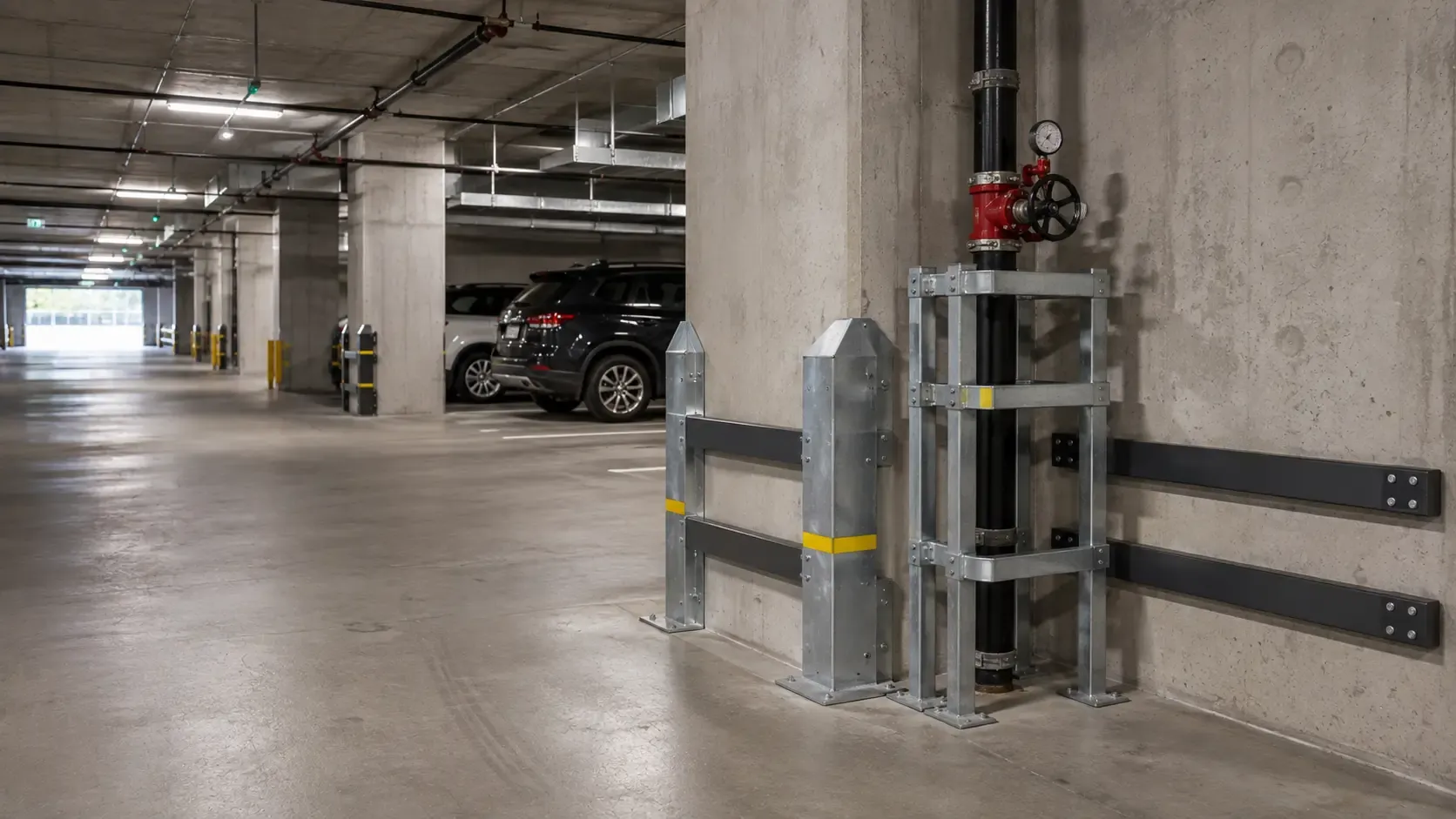
Parkade Pipe Guards, Column Guards and Rub Rails
Guards for the parts of a parkade that keep getting hit: sprinkler and standpipe risers, downspouts, columns, walls and corners.
Underground parkades take damage nobody reports. A sprinkler line clipped at the ramp. A column worn through at bumper height. A downspout crushed in the drive aisle. None of it happens dramatically — it accumulates, one low-speed contact at a time, until something leaks or a repair invoice arrives that costs more than protecting it ever would have.
TrussMetal fabricates and installs guards for the parts of a parkade that keep getting hit: sprinkler and standpipe risers, downspouts and rainleaders, columns, walls, corners, and the utility equipment that ended up somewhere a vehicle can reach.
This is retrofit work almost every time. The parkade already exists, it’s in use, and it can’t close. That constraint shapes everything below.
Send us photos of what keeps getting hit.
What This Page Is, and What It Isn’t
Everything here is protection intended to reduce incidental and low-speed damage — the daily contact between vehicles and building infrastructure in a parking structure. Guards absorb and deflect that contact so the pipe, column or wall behind them doesn’t.
That is a different category from an engineered or tested vehicle-impact system. Those are designed and verified against a defined performance requirement, and their capability comes from testing and engineering — not from being made of heavy steel. A fabricated guard does not carry a rating, and we don’t claim one for it.
If a project specification calls for certified vehicle-impact performance, that requirement needs to be identified at the outset and addressed with an appropriate engineered or tested system. Where engineered design or sealed documentation is required, it should be provided or reviewed by the appropriate qualified professional. Send us the specification and we’ll tell you which category it’s asking for.
What We Protect
→ Custom bollards for vehicle protection
Sprinkler and standpipe risers
The highest-consequence item in most parkades. A struck sprinkler line is a flood and a fire-protection impairment at the same time, and both carry costs well beyond the pipe. Risers at ramp entries, at aisle ends and at the corners vehicles cut are the usual casualties.
Protection is typically a guard set clear of the pipe so contact is transferred to the guard rather than through it — which means the standoff and the fixing matter as much as the guard. Fire protection systems have their own clearance and access requirements, and any guard has to be arranged so it doesn’t obstruct inspection, valves or heads. That should be confirmed against the system and the authority having jurisdiction rather than assumed.
Downspouts and rainleaders
Frequently run down a column face or along a wall in exactly the zone a bumper occupies. They’re thin-walled, cheap to damage and disproportionately expensive to repair once water starts finding its way into the structure. Guards here are usually a partial wrap or a standoff bracket arrangement rather than a full enclosure, because access for maintenance still has to work.
Columns
Columns take the most contact and show it first: spalled concrete, exposed reinforcement, and paint worn to bare surface at bumper height. Protection ranges from corner angles on the leading edges, to rub rails across the face, to a full or partial column wrap.
The choice is driven by how the column is being hit. A column at the apex of a turn gets cornered; a column beside a stall gets nudged square-on; a column at a ramp gets both. Wrapping a column that’s only ever hit on one corner is money spent where it isn’t needed.
Rub rails and wall protection
Horizontal rails set at contact height along walls, aisle ends and stall lines, so a vehicle contacts steel rather than concrete or drywall. Continuous rails suit long runs; discrete sections suit specific problem points.
What decides the detail is the wall itself — concrete, block, drywall over stud, or a membrane-backed assembly all take a fixing differently, and the fixing is where a rub rail succeeds or fails.
Corner guards
Walls, columns and equipment enclosures all lose their corners first. Angle or formed guards take the hit and can be replaced individually when they’ve done their job, which is the point of them.
Utility and equipment guards
Electrical rooms, transformers, gas meters, generators, EV charging equipment, bike room walls and storage enclosure faces all end up in a parkade with vehicles moving past them. Where a utility sets its own protection standard, that standard governs — which utility and which document should be confirmed, because they differ and are sometimes inspected.
Working in an Occupied Parkade
This is the part that decides whether the job goes well. A parkade is not a construction site — it’s a building system that residents and tenants use every day, with a fixed number of stalls and no spare capacity.
Phasing
Work is broken into sections so the parkade stays usable throughout: a run of stalls, an aisle, or one level at a time, rather than the whole structure at once. Which sections and in what order is worked out with building management before anything starts, because they know which stalls are hardest to relocate and which tenants have constraints you’d never guess from a drawing.
Keeping the parkade operational
Entries, exits, ramps, fire routes and loading access have to keep working. Where a work zone would close one of them, the sequence changes rather than the access. Where a fire route is affected even temporarily, that needs to be raised with building management and the authority having jurisdiction in advance.
Stall access
Affected stalls are identified in writing before work starts so notice to residents or tenants can name the stall numbers and dates rather than say “work will occur this week”. Vehicles that don’t move are the most common cause of a lost day on this work, and specific notice is what prevents it.
Dust and noise
Drilling and cutting in an enclosed concrete structure generate both, and both travel further underground than people expect — up ramps, through stairwells, and into the suites above. Dust control at the source, containment of the work zone, and scheduling the noisiest operations into agreed windows are all part of the plan rather than afterthoughts. Grinding dust settles on parked cars, so protection of adjacent vehicles is planned, not improvised.
Work-zone control
The work area is delineated and kept closed to vehicles and pedestrians while it’s live, with a route past it maintained where the aisle is the only way through. Overnight, nothing is left in a position where a driver could hit it or a resident could walk into it.
Scheduling
Some parkades are easiest to work in during business hours; others are effectively empty overnight or on weekends. Which applies is project-specific and depends on the building, the tenants and the parking pattern — so the schedule is set with building management rather than assumed. Extended, after-hours or weekend working can be arranged where the project calls for it and the building permits it.
Coordination with building management
One point of contact, an agreed sequence in writing, and notice content that management can post without rewriting. For strata buildings this work is frequently a depreciation report item and needs a scope and price a council can vote on.
Fixing Into Existing Concrete
Everything on this page is anchored into concrete somebody else poured, often decades ago, in a structure that may be post-tensioned. That makes existing conditions the first design input, not a site detail.
Existing concrete may contain reinforcement, post-tensioning, embedded conduit, drainage, in-slab heating, waterproofing membrane or other concealed conditions. Where appropriate, locating or scanning may be required before drilling, and should be coordinated as part of the project scope along with any available structural drawings or as-built information.
What has to be understood before an anchor location is fixed:
- Post-tensioning. In a post-tensioned slab, tendon locations are not something to be inferred from experience or worked around by assumption. Existing structural information and appropriate investigation may be required before drilling, and where there is doubt about a location, it should be resolved rather than estimated. A damaged tendon is a structural event, not a repair item.
- Reinforcement. Even in conventionally reinforced concrete, bar locations affect where an anchor can go and how deep it can be set.
- Edge conditions. Anchors near a slab edge, a column face, a construction joint or a saw cut behave differently from anchors in the middle of a member. Proximity to an edge is a design constraint, not a preference.
- Existing damage. Spalled concrete, exposed and corroding reinforcement, and previously repaired areas may not be suitable to anchor into at all. In some cases the concrete repair has to happen before the protection is installed — and identifying that early is cheaper than discovering it mid-installation.
- Embedded services. Conduit, drain lines and heating are routinely found where drawings don’t show them.
- Membrane and waterproofing. On a suspended slab or a topped deck, penetrating a membrane creates a leak path that has to be detailed rather than sealed as an afterthought.
We don’t publish anchor types, sizes, spacings or embedment for this work, because the correct values depend on the substrate, its condition, the loads being resisted and any applicable design requirements. Where an anchor design or sealed documentation is required, it should be provided or reviewed by the appropriate qualified professional. Where a project has an engineer’s detail, we build to it.
Materials and Finishes
A parkade is wet, salted for half the year, and poorly ventilated in the places where water sits longest. Coatings take physical damage from the impacts the guards exist to absorb.
Hot-dip galvanizing is the baseline for steel in this environment. It coats inside hollow sections as well as out, which matters on posts and pipe guards standing in run-off. Coating over galvanizing — a duplex system — adds a specified colour with better life than coating alone, and is the sensible default where appearance or visibility is part of the requirement. High-visibility finishes — safety colours, banded schemes and retroreflective elements — are what make a guard get seen in a dim parkade, and they’re the cheapest part of the job to get right.
Galvanizing and coating are carried out by specialist applicators. Coordinating the coating system with fabrication means it’s matched to the material, the exposure and the intended appearance before anything is built.
Two things drive corrosion on this product: damaged coating that nobody touches up, which starts rust exactly where the guard is doing its job, and trapped water in hollow sections and at the base of anything standing on a slab that drains toward it rather than away. Guards designed to drain and to be re-coated after impact outlast guards specified for a better initial finish.
Material notes: steel and stainless steel.
When to Repair and When to Replace
Guards are consumable by design — they take the damage so the structure doesn’t. A guard that’s been hit and deformed has worked.
Where the fixing is sound and the damage is local, replacing a section is usually cheaper than a full run, and we’ll say so rather than pricing the whole aisle. Where the anchor or the concrete around it has failed, that’s a different job, and the concrete may need attention before anything is re-fixed. Where a guard has been hit repeatedly in the same spot, the useful question isn’t the guard — it’s why the geometry keeps producing the same contact, because a re-positioned guard or a different approach often solves it permanently.
→ Mobile welding and on-site repairs
Who This Is For
Strata corporations and property managers dealing with recurring parkade damage, often as a depreciation report item. Commercial building managers with tenant complaints and repair costs that keep repeating. General contractors and developers with parkade protection in a package. Facility managers who have repaired the same column three times.
Where We Work
Our shop is at 5128 Francisco Court in North Vancouver. We fabricate and install across Metro Vancouver and the Lower Mainland, including Vancouver, North Vancouver, West Vancouver, Burnaby, Richmond, Coquitlam and Surrey.
Questions We Get Asked
Do we have to close the parkade?
No. This work is phased so the parkade stays usable — a run of stalls or an aisle at a time, with the sequence agreed with building management before anything starts and affected stalls identified in writing so notice can be specific.
Are your guards crash-rated?
No. What we fabricate is protection intended to reduce incidental and low-speed impact damage. Certified vehicle-impact performance comes from engineered and tested systems, not from heavy steel. If your specification calls for a rating, send it and we’ll identify what it’s actually asking for.
Can you drill into a post-tensioned slab?
Anchoring into any existing slab starts with understanding what’s in it. Existing structural information and, where appropriate, locating or investigation may be required before drilling, and should be coordinated as part of the project scope. Where doubt exists about a tendon location, it gets resolved rather than estimated. Where an anchor design is required, it belongs to the appropriate qualified professional.
How do we know what to protect first?
Photograph what’s already been hit. Damage history is the best available guide to where the next impact will happen, and it usually points at three or four specific locations rather than the whole structure.
Can guards be installed around fire protection equipment?
Guards can be arranged so they don’t obstruct inspection, valves or heads, but fire protection systems have their own clearance and access requirements and these should be confirmed against the system and the authority having jurisdiction rather than assumed.
Can this be done in phases across budget years?
Yes, and for strata buildings that’s often how it’s funded. Work can be priced by level, by aisle or by problem location so a council can approve one portion with a known figure for the rest.
Send us photos of what keeps getting hit
You don’t need a scope. Photographs of the damaged columns, pipes or walls — and a note on which level and aisle — are enough for us to tell you what’s worth protecting and roughly what it involves.
Email sales@trussmetal.com or call (778) 805-5333. We can also arrange a parkade walk-through and quote against a marked-up level plan.