
Steel Fabrication
Mild and hot-rolled steel — the workhorse. Strong, weldable, economical, and it takes a finish well.
Where Steel Works Best
Steel is what most of what we build is made from, and for good reason. It is stiff, so a gate frame in steel can use a lighter section than the same gate in aluminum and still not sag over a three-metre span. It welds cleanly with equipment every shop already owns. And when a design changes on site — which it does — steel can be cut, re-fitted and re-welded without the job turning into a science project.
Where it earns its keep: driveway gates, stair stringers, structural posts, pergola frames, and anything carrying a load. Where it does not: unpainted exterior work you will never maintain, and anything in direct contact with saltwater. Steel rusts. Everything below is about controlling when.
Grades We Stock
Most residential and light commercial work is A36 mild steel — plate, flat bar, angle and channel — plus hollow structural section in square and rectangular tube for frames and posts. For pickets, balusters and infill we use solid round and square bar.
Hot-rolled carries a dark blue-grey mill scale and slightly rounded edges. It is cheaper, and the scale has to come off before any coating goes on. Cold-rolled is dimensionally tighter with a smooth grey surface, which matters for interior furniture and anywhere the raw metal is the finish.
If a piece has to be certified, say so at the drawing stage and we will source it with mill certs rather than substituting later.
Cost Compared to Other Metals
Steel is the cheapest metal we work in per kilo, and the cheapest to fabricate, because it welds fast and needs no special gas or surface preparation.
As a rough ordering for the same piece, least to most expensive: steel, aluminum, stainless, brass. But material is only part of a quote. A stainless railing with a simple profile can land closer to a steel one than you would expect, and an ornate steel gate can cost more than a plain aluminum one twice its size. Labour and complexity move the number more than the metal does.
If budget is the deciding factor, give us the number at the consultation. We would rather design to it than quote past it.
Where Steel Makes Sense
Steel is the default for most of what we build, and the reason is not cost. It is that steel does more things acceptably than any other material does: it takes any profile, any connection and any finish, it is strong for its section size so parts can be slim, and — the property people forget — it is repairable. A damaged steel section can be cut out and replaced on site. Most alternatives cannot.
It carries the load on railings and guards, gates, stairs, fencing, canopies and bollards, and it is what we reach for whenever strength, impact resistance or repairability matters more than weight.
Where Steel Is the Wrong Choice
Steel rusts. Everything else about it is a decision; that one is a fact, and it is managed rather than avoided. Where the environment is aggressive and the finish will not be maintained, steel is the wrong answer and we will say so.
It is also heavy. On a balcony replacement where every section is carried up by hand, on a rooftop where the supporting structure is constrained, or on a wide gate leaf where hinge loading is the limit, the weight of steel is a real cost and aluminum often wins. Where the metal itself is the finish and will be handled or is close to salt water, stainless is usually the more defensible specification.
Hot-Rolled, Cold-Rolled and Mill Finish
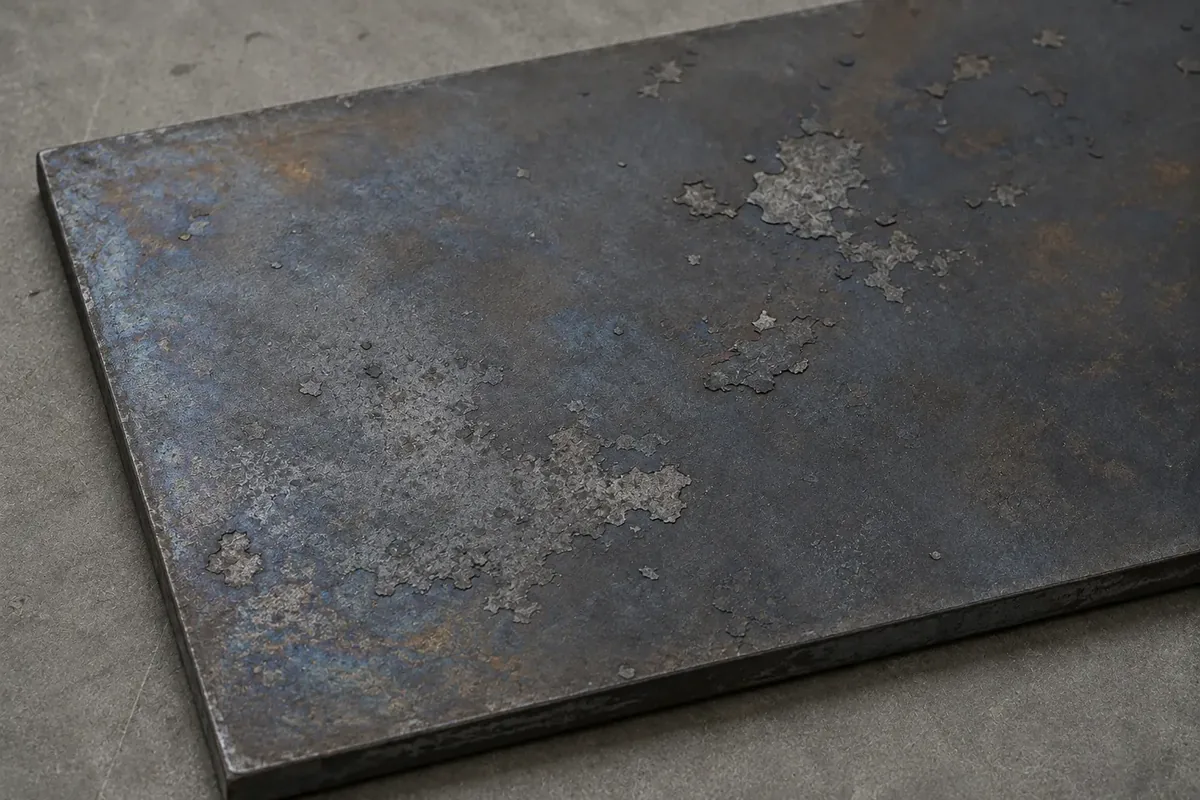
Hot-rolled steel carries mill scale and a slightly rougher surface with visible variation. That surface is a feature in interior architectural work — the clear-coated hot-rolled look — and something to be removed before coating in exterior work.
Cold-rolled is smoother, more dimensionally consistent and better suited to visible sheet work where flatness matters, such as fireplace surrounds and furniture. It is the sheet our steel display pedestals are folded and welded from.
The mill surface also carries markings, and on a large flat panel those show under raking light. Whether that is character or a defect is a conversation to have before fabrication, with a sample in hand.
Exterior and Coastal Exposure
Metro Vancouver is wet for much of the year, and the North Shore and the waterfront add salt spray to that. Two things follow.
First, hollow sections rust from the inside where nobody can see it. That is the entire argument for hot-dip galvanizing over paint on exterior tube — galvanizing coats the inside surface as well as the outside.
Second, the failure always starts at an edge, a weld or a fixing. Cut edges, weld zones and drilled holes are where coating is thinnest or has been destroyed, and that is where the first rust bloom appears. Detailing that lets water drain and dry, rather than sit in a section, does more for service life than any coating upgrade.
Finishes for Steel
Steel takes more finishes than any other metal we work. The choice is set almost entirely by whether the piece lives indoors or out.
- Outdoors — powder coat in any RAL colour. Within sight of salt water we hot-dip galvanize first and powder coat over it, because the zinc keeps protecting the steel where the coating gets chipped.
- Indoors, coloured — the same powder coat, usually in a matte or fine-texture finish.
- Indoors, dark and metallic — chemically blackened steel sealed with wax, oil or lacquer, or a black or brown patina for something deeper and less even.
- Indoors, raw — the blue-grey mill scale left on hot-rolled plate, sealed with wax or clear lacquer and otherwise left alone. It is really the absence of a finish, and it comes with fingerprints and a soft patina that some clients want and others are surprised by. We will always ask which you are.
None of the interior finishes survive outdoors here. For how they compare across every metal we work, see metal finishes.
Fabrication Considerations
Welding puts heat into steel and heat moves it. On a long, flat or slender part, distortion is controlled through fabrication sequence, stiffening and sometimes deliberate pre-set rather than by welding harder. It is a real cost driver on visible work and it is why a flat panel that stays flat costs more than one that does not.
Show faces get identified before anything is cut, so grinding marks and the rougher mill side end up where they are not seen. Welds on visible work are dressed and blended rather than simply ground back.
Finishing sequence matters as much as finish selection. Galvanizing happens after all fabrication and drilling — a hole drilled afterwards breaks the coating at exactly the wrong place. Where something has to be welded on site, the coating at that point has to be made good afterwards or it becomes the rust starting point.
Maintenance
Exterior steel is not maintenance-free and nobody should tell you it is. Coated steel wants an occasional wash to remove salt and grit, an eye on the fixings and the base connections, and touch-up where something has chipped through to metal. Catching a chip early is the difference between a touch-up and a section replacement.
Steel or Aluminum?
Steel where strength, repairability, impact and cost matter most — driveway gates, guards, stairs, bollards, anything that gets hit. Aluminum where weight, handling or corrosion dominate — balcony work, rooftop structures, long fence runs, and close to open water. Both are correct answers to different sites, and the site usually decides rather than the preference.
Related Products
Steel is the primary material on railings, gates, fencing, stairs, canopies, bollards, storage cages and waste enclosures. Send a drawing or a photo and we will tell you whether steel is the right call for your situation.
Free in-house consultation
We come to you, measure the site, and talk through options and budget before you commit to anything. No charge, no obligation.
Call (778) 805-5333 or email sales@trussmetal.com