
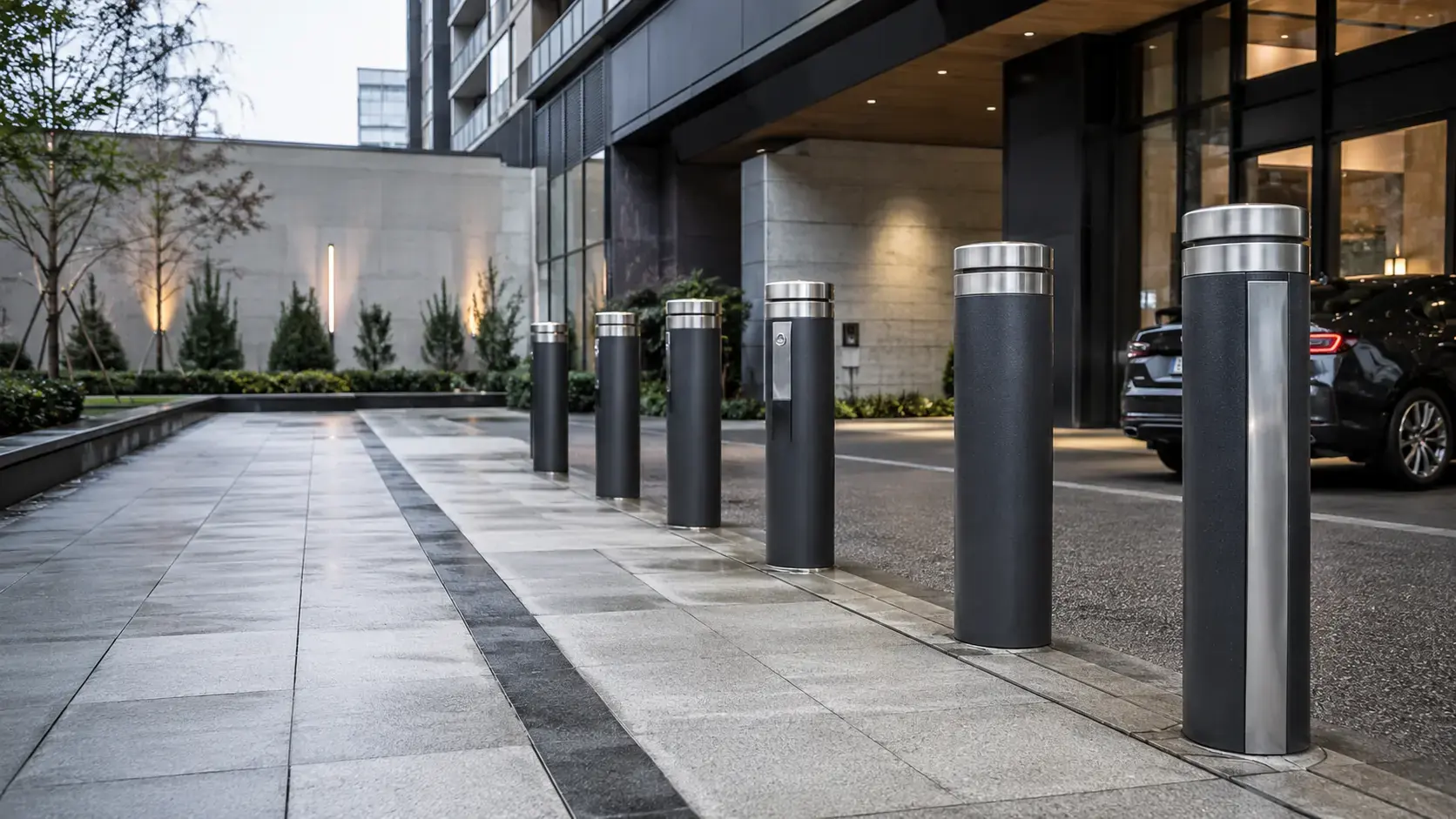
Custom Steel and Stainless Bollards
Fixed, removable, collapsible, decorative and sleeved bollards in steel, stainless and aluminum, built to the dimensions and finish a project calls for.
A bollard is a simple object with a lot of decisions inside it. How it’s fixed. What it’s actually protecting against. Whether it has to come out. And how it survives salt air, road spray and standing water at the one point on a site where all three collect.
TrussMetal fabricates bollards in North Vancouver — fixed, removable, collapsible, decorative, sleeved and combination units — in steel, stainless and aluminum, built to the dimensions and finish a project calls for rather than to a catalogue size.
We don’t hold a standard bollard, so we can’t quote from a product code. We quote from a photo, a drawing, or a look at the site. Fabrication and installation can be coordinated together as part of the project scope, so the piece that arrives is the piece that was drawn.
Send a photo or a drawing and we’ll tell you what you’re looking at.
Bollards We Fabricate
Fixed bollards
A post permanently fixed in place, protecting a storefront, a wall, a utility cabinet, or a corner that keeps getting hit.
Fixed bollards can be embedded into new concrete, core-drilled and grouted into an existing slab, or set on a base plate anchored to the surface. Which is right depends on what’s under the surface, what the bollard is protecting against, and whether the slab can be broken into at all.
Round pipe is most common, but a fixed bollard can also be square, tapered, or a fabricated profile. Concrete filling is a configuration option rather than a default — it changes how the post behaves under impact and how water behaves inside it.
Removable and lift-out bollards
Where access has to be controlled but not permanently blocked: fire lanes, loading areas, service driveways, event spaces.
A removable bollard is two parts — the post, and a receiver set into the ground. The receiver decides whether the system still works five years later. It collects water, grit and road salt, and with no drainage path it will seize, corrode, or freeze solid over a winter.
Settle early whether it locks and with what, whether the receiver takes a cap when the post is out, and where the post lives when it isn’t in the ground — the most common reason removable bollards stop being removable. We fabricate posts and receivers together, and can supply posts to fit receivers already in place.
Collapsible and fold-down bollards
A hinged post that folds flat instead of lifting out. Useful where there’s nowhere to store a removed post, or where a lift-out is too heavy for whoever actually has to move it.
The trade-offs are real: the folded post sits proud of the surface, the hinge and lock are exposed to everything that runs across them, and the assembly takes impact differently from a fixed post. Where a site is washed down or heavily swept, the mechanism needs specifying with that in mind. We can also retrofit fold-down units into existing bases where the base is sound.
Decorative and architectural bollards
Where a bollard has to belong to the building rather than only protect it. Tapered and stepped profiles, ring tops, banded details, faceted forms, or a shape drawn for the project.
Decorative doesn’t have to mean cast. A fabricated bollard can carry a profile that would otherwise need a casting pattern, at a run size where a casting makes no commercial sense. It can also be built as a decorative sleeve over a structural core, separating how it looks from what it does. We fabricate to drawing, and can produce a sample before committing a run.
Security and anti-ram bollards — read this before specifying
A heavy steel bollard is not a crash-rated bollard. Crash ratings come from physical testing of a complete system — post, foundation and installation together — against a defined test standard. A bollard cannot inherit a rating from its wall thickness, its diameter, or how solid it feels.
TrussMetal fabricates custom bollards. We do not perform crash testing and we do not certify systems. Where a specification calls for a tested and certified vehicle-security barrier, that requirement is met by a proprietary system carrying the applicable certification, installed to its tested detail — not by a custom fabricated post, however heavy.
What we can do is fabricate the surrounding metalwork, match adjacent custom bollards to a certified unit’s appearance, and be straight with you about which category your requirement falls into. If you’re not sure, send the specification and we’ll read it.
Bike bollards and combination units
A bollard that also works as bike parking, or a bike rack detailed as a bollard. Common on plazas and at retail frontages, where a site is trying to make one element do two jobs.
Check before specifying whether the piece has to count toward a bike parking requirement. That’s determined by the applicable local bylaw and the rack type it accepts — not by whether a bike can physically be locked to it.
Bollard sleeves and covers
A sleeve slips over an existing bollard, changing how it looks without touching what’s underneath. Stainless, powder-coated steel or aluminum, in plain, banded or reflective versions.
Often the cheapest useful thing you can do to a tired site: a row of rusted, mismatched, repeatedly-repainted posts becomes consistent in an afternoon, with no excavation and no concrete work. It also protects the post underneath — provided the sleeve is detailed to drain rather than trap water against the steel. That detail is the difference between a sleeve that extends a post’s life and one that quietly ends it.
How a Bollard Actually Gets Specified
There is no such thing as a standard bollard specification, and any supplier publishing one table of diameters and embed depths is describing their own stock rather than your site.
Diameter, wall thickness, height above grade, embedment, footing size, base plate thickness and anchor spacing are all outputs of a situation, not inputs to it. They depend on what the bollard is protecting against, what vehicles reach it and at what speed, what’s below the surface, whether the concrete is new or existing, and whether a drawing, an engineer, a utility or a municipality has already set them. Publishing one set of numbers as universal would be easy, and would be wrong on most sites it was applied to.
So instead of a specification table, here is how the specification gets arrived at.
| Application | Typical configuration | Mounting approach | Primary design consideration | What we need to confirm |
|---|---|---|---|---|
| Storefront and building face | Fixed steel bollard | Embedded, or a project-specific base plate | Vehicle exposure, and the protection level actually wanted | Slab or footing condition, what runs below, position relative to the entrance and accessible route |
| Fire lane and emergency access | Removable or fold-down post | Receiver set into concrete | Must be openable by the authority having jurisdiction, on their terms | That authority’s requirements for the route, who holds the key, required clear width and spacing |
| Parkade entry, ramp, drive aisle | Fixed bollard, often galvanized or sleeved | Core-drilled, or base plate where the slab can’t be broken into | Slab construction and what’s inside it | Whether the slab is post-tensioned, membrane and service locations, drainage, equipment headroom |
| Utility and equipment protection | Fixed bollard, often to the utility’s own standard | As specified by the utility | The utility sets the requirement — the site owner doesn’t | Which utility, which standard document, and whether they inspect before energising |
| Plaza, park and streetscape | Decorative or architectural bollard | Embedded, or base plate on a structural slab | Appearance, accessible circulation, matching adjacent units | Accessible route requirements, existing profile and finish if matching, who owns the surface |
| Loading dock and service yard | Fixed bollard, usually high-visibility | Embedded in new concrete, or core-drilled | Repeated low-speed impact, and how easily a damaged post is replaced | Vehicle types and turning paths, floor construction, whether replaceability beats permanence |
| Waste and recycling areas | Fixed bollard, high-visibility | Embedded or core-drilled | Bin and truck impact on enclosure corners and gates | Bin movement path, truck swing, existing pad condition |
| Bike parking and combination | Bollard-form rack or combination unit | Embedded or surface-mounted | Whether it must count toward a bylaw bike-parking requirement | The applicable bylaw, rack types accepted, required spacing and clearances |
| Replacing damaged units | Match existing | Match existing where the base is sound | Matching profile, height and finish so the run reads as one | Photographs and measurements of the existing units, condition of the base or receiver |
Where a project has drawings, we build to them. Where it has an engineer’s detail, we build to that. Where it has neither and the exposure is significant — a bollard protecting people rather than property, or one expected to stop a vehicle — that’s a case for engineering input, and we’ll say so rather than pick a number.
Embedded, Core-Drilled, Surface-Mounted or Removable
Embedded in new concrete
The straightforward case: the post is set before or during the pour, into a footing sized for the situation. What makes it work is coordination, not complexity — position right before the concrete arrives, post held plumb while it sets, and finished height accounting for whatever surface goes on top. Getting the height wrong is the most common error and the least fixable one.
Core-drilling into existing concrete
Most bollard work happens on sites that already exist, which means drilling into a slab somebody else poured. Existing concrete may contain reinforcement, post-tensioning, embedded services, in-slab heating or waterproofing membrane. Where appropriate, locating or scanning may be required before drilling, and should be coordinated as part of the project scope along with any available structural drawings or as-builts.
Depth is limited by what’s there. A suspended slab may not permit meaningful embedment at all — in which case a surface-mounted base plate is the correct answer rather than the compromise answer. The surface is then restored so water drains away from the post rather than into the hole around it.
Surface-mounted base plates
A plate welded to the base of the post and anchored to the surface. Used where embedment isn’t possible — suspended slabs, membranes, congested services — or where the assembly has to be removable for future work.
Base plate performance is entirely about what it’s anchored into. Plate, anchors and concrete behave as one system, and the weakest sets the result. This is the mounting method most often specified by an engineer rather than chosen by preference, and where impact is expected it should be.
Removable receivers
The receiver is where removable bollards succeed or fail, and nearly every failure is water.
- Drainage. A receiver is a hole in the ground with a lid. With no drainage path it holds water — which in a Vancouver winter means a post frozen in place on exactly the day someone needs it out.
- Corrosion inside the sleeve. The inside of a receiver is the least accessible and wettest part of the assembly, and usually fails first. Galvanizing inside as well as out, or a stainless receiver, is worth the difference where the location is hard to get back to.
- Grit. Sweeping and washdown carry sand into an open receiver until the post no longer seats. A cap solves it — if somebody uses it.
- Locking. Check whether the fire department requires a particular locking or key arrangement on any route they need.
- Storage. A removed post with nowhere to go ends up leaning against a wall and eventually disappears.
We fabricate receivers detailed to drain, and posts to fit receivers you already have.
Materials
Steel is the default — strongest per dollar, takes any finish, welds and repairs easily. Left unprotected it corrodes, so on an exterior bollard the coating system matters as much as the steel. See steel.
Stainless gets specified where appearance has to hold up without repainting, and in high-visibility architectural work. Grade selection matters more than people expect near salt air — 304 in sheltered inland conditions, 316 the more defensible choice where salt spray reaches and washing is infrequent. It isn’t maintenance-free: weld heat tint or embedded steel particles will stain if the surface isn’t properly finished. See stainless steel.
Aluminum appears mostly in decorative sleeves and lightweight non-impact applications. Light, doesn’t rust, anodises well — but softer than steel, and it behaves badly against steel or wet concrete unless isolated. See aluminum.
Pipe is specified by nominal size and by schedule — Schedule 40 and Schedule 80 being the common designations. Which belongs on your project is part of the specification, not a house standard.
Finishes and Coastal Exposure
Metro Vancouver is a wet marine environment, and a bollard sits at the worst point in it: at grade, splashed with road salt, standing in whatever pools around its base.
Hot-dip galvanizing is the baseline for exposed exterior steel. It coats inside and out, which matters on a hollow post and matters more on a receiver. Carried out by specialist galvanizers, not in our shop.
Powder coating gives a specified colour and a hard finish. Over bare steel it depends entirely on preparation; over galvanizing — a duplex system — it outlasts either alone by a wide margin, and it’s what’s worth specifying on anything coastal. Duplex depends on correct pre-treatment, worth naming in the specification rather than leaving to the applicator. Coating is done by specialist applicators.
Reflective banding where a bollard sits in a vehicle path or a dim parkade. Inexpensive, most often left off, and frequently the difference between a bollard being seen and being hit.
Three things cause most early bollard corrosion, and none is choosing the wrong material: water sitting at the base because the surface drains toward the post; water trapped inside a hollow post or receiver with no route out; and coating damaged during installation and never touched up. How the post meets the surface matters more than the coating specification written above it.
Placement, Clearance, and Who Actually Sets the Requirement
Bollard spacing and placement are frequently governed by somebody other than the person paying for them. Establish which of these applies before assuming a layout — because when one does, its requirement governs.
The municipality. Cities across Metro Vancouver publish engineering design standards and streetscape requirements that can govern bollards in or adjacent to public right-of-way — spacing, clearance, appearance, sometimes a specific product. Requirements differ between municipalities, and between a private site and the right-of-way on the same street. Confirm with the municipality that has jurisdiction rather than assuming a neighbour’s standard carries across.
The utility. Protection around transformers, gas meters and electrical kiosks is typically set by the utility’s own standard, covering placement, clearance and sometimes the bollard itself. BC Hydro and FortisBC each publish their own requirements. These are usually non-negotiable and sometimes inspected before equipment is energised.
The fire department. Anything on a fire access route — spacing, clear width, whether removable bollards are permitted at all, and what locking arrangement is acceptable — is determined by the authority having jurisdiction. Confirm before fabrication, because this is the one that gets removed at somebody else’s cost.
Accessibility. Where a bollard sits on a pedestrian route, clear width and detectability requirements apply. A bollard placed to solve a vehicle problem can quietly create a pedestrian one.
We deliberately don’t publish generic clearance and spacing figures, because the only number that matters is the one from whichever authority governs your site. What we can do is read the requirement with you, build to it, and tell you plainly when you need to go and ask rather than guess.
What Goes Wrong
- Set too shallow for what it’s protecting. A bollard that looks identical above grade can behave completely differently below it.
- No drainage in the receiver. Removable bollards that can’t be removed: frozen, seized, or silted solid.
- Coating damaged during installation and never touched up, starting corrosion at the point most exposed to salt.
- Dissimilar metals in contact. Stainless fixings through galvanized steel, aluminum against steel, metal cast into wet concrete without isolation.
- Surface draining toward the post. The restoration detail is part of the bollard, not an afterthought to it.
- Anchors chosen by eye. On a surface-mounted plate the anchors are the design.
- The wrong category entirely — a custom bollard specified where the requirement was for a certified vehicle-security system, which surfaces during review at the worst point in a project.
Installation and Site Restoration
Fabrication and installation can be coordinated as part of the project scope, so the same drawing carries through from the shop to the ground.
Existing conditions first. On any existing surface, what lies below has to be understood before anything is cut. That means structural drawings or as-builts where they exist, and locating or scanning where the situation calls for it — arranged as part of the project scope. On a suspended or post-tensioned slab this is not a step to skip.
Working around an occupied site. Most bollard work happens at operating businesses and lived-in buildings, so stalls, entrances and loading access come out one at a time, and you get the sequence in writing so your notice can be specific.
Curing. Concrete and grout need time before a bollard does its job. Where a fire lane or loading door has to reopen, that gets planned around rather than discovered.
Restoration. Asphalt, pavers and concrete are made good, and the finished surface graded so water runs away from the post. Pavers are cut and reset rather than filled around. This is the part people actually look at afterwards, and the part cheap installs skip.
Replacing and Matching Existing Bollards
A large share of bollard work is replacement: a post sheared off at the base, a run where three of eight have gone missing, or a set repainted so many times the profile has disappeared.
To match an existing unit we need photographs, a few measurements and a note on the finish. Where the existing base or receiver is sound, replacing only the post is normally cheaper and avoids breaking into the surface at all. Where the base has failed, that’s a different job, and we’ll tell you which one you have before quoting rather than after starting.
Matching a discontinued unit is a fabrication problem, which is exactly what a custom shop is for.
Who We Build For
Property managers and strata corporations replacing damaged bollards on occupied buildings. General contractors and developers with bollards drawn into a package. Retail operators protecting a storefront after an incident — or before one. Architects and landscape architects specifying a profile that doesn’t exist in a catalogue. Facility managers dealing with the same corner being hit for the third time.
Where We Install
Our shop is at 5128 Francisco Court in North Vancouver. We fabricate and install across Metro Vancouver and the Lower Mainland — Vancouver, North Vancouver, West Vancouver, Burnaby, Richmond, Coquitlam and Surrey.
Bollard Questions We Get Asked
How deep does a bollard need to be set?
There’s no single answer, and anyone giving you one without seeing the site is quoting their own stock rather than your situation. Embedment depends on what the bollard is protecting against, what’s below the surface, whether the concrete is new or existing, and whether a drawing, an engineer or a utility has already set it. On a suspended parkade slab, meaningful embedment may not be possible at all.
Can you install without breaking up the whole slab?
Usually. Core drilling takes out a clean disc rather than a section, and surface-mounted plates need no breaking at all. What decides it is what’s inside the slab — which is why locating comes before cutting.
Are your bollards crash-rated?
No, and no custom fabricated bollard is. Crash ratings come from testing a complete system — post, foundation and installation — against a defined standard. Where a project genuinely requires a certified vehicle-security barrier, that calls for a proprietary system carrying the applicable certification. If your specification mentions a rating, send it and we’ll tell you which category you’re in.
What does a bollard cost installed?
It depends on more than the post: how many, the mounting method, what’s under the existing surface, the finish, and the restoration needed. Several bollards on one visit cost far less each than a single unit, because most of the cost is mobilising and surface work rather than steel. Send the count, a photo and the location and we’ll give you a number.
Can you match our existing bollards?
Usually. Send photographs, whatever measurements you can take, and a note on the finish. Where an existing base or receiver is still sound, replacing just the post is normally the cheaper route.
Do removable bollards need a special key?
They can be built to lock or to lift freely. On a fire access route the locking arrangement isn’t your choice — confirm what the authority having jurisdiction requires before anything is fabricated.
Will it survive the salt air?
With the right finish and, more importantly, the right base detail. Hot-dip galvanizing is the baseline for exposed steel, and a duplex system suits anything close to the water. But most early corrosion comes from water sitting at the base or trapped inside the post. Drainage does more than the finish schedule does.
Do we need a permit?
On private property, often not. In or adjacent to public right-of-way, frequently yes, and requirements vary by municipality. Where a bollard protects utility equipment, the utility may need to review it regardless. We’ll flag what we think applies, but confirmation comes from the authority, not from us.
Send us a photo, a drawing, or just the address
You don’t need to know the specification to get a quote. A photo of what needs protecting, a drawing, rough dimensions, a count, or a sentence about what keeps getting hit — any of those is enough to start.
Email sales@trussmetal.com or call (778) 805-5333. If it needs seeing, the site visit is free, and we’ll measure and quote against a drawing rather than a guess.