
Corten Steel
Weathering steel that forms its own protective patina — planters, screens, facades and signage.
How Corten Weathers
Corten is steel alloyed with copper, chromium, nickel and phosphorus. It rusts like any steel, but the rust it forms is dense and tightly bonded rather than flaky, and that layer then slows further corrosion instead of accelerating it. Left alone, it protects itself.
It needs wet and dry cycles to do this. Rain, then drying, repeatedly. Corten kept permanently wet — in standing water, buried in soil, sandwiched against a surface that stays damp — never stabilises and will keep corroding straight through. Corten kept permanently dry indoors never develops the patina at all and just looks like slightly odd steel.
Vancouver, as it happens, is close to ideal for it. Wet winters and dry summers give exactly the cycling the alloy wants.
Runoff and Staining
This is the part nobody mentions until it has already happened.
For roughly the first year, rain running off Corten carries iron oxide with it and stains whatever it lands on. Concrete, pavers, stucco, cedar decking, light-coloured stone — all of it will take an orange-brown mark, and on porous surfaces the mark is effectively permanent.
It is entirely manageable if it is designed for. We detail drip edges to throw water clear, set planters on gravel or a sacrificial layer rather than straight onto finished concrete, and keep the base of screens off pale hard landscaping. Where the surface below is precious, we will say so before anything is fabricated.
After the patina stabilises, runoff drops off sharply. It never quite reaches zero.
Planters and Screens
Planters are the most common Corten job we build, and the one with the most ways to get it wrong.
A planter must drain freely and the steel must not sit in wet soil indefinitely. We build with a drainage gap and a raised base, and for anything permanent we recommend an internal liner so the growing medium never touches the plate directly. Wall thickness matters too — soil pushes outward with real force, and a planter that looks fine empty will bow visibly once it is full and watered.
Screens and privacy panels are the easier win. Laser or plasma-cut patterns in Corten plate throw good shadows, need no finishing, and are one of the few exterior features that genuinely improve with age. The main design constraints are wind loading and how the panel is fixed, both of which we work out at the drawing stage.
Facades and Cladding
On facades and cladding, Corten becomes an assembly problem more than a metal problem.
The panels themselves are straightforward. What matters is everything behind them: a ventilated cavity so both faces can dry, fixings and a substructure in stainless or an equally durable material, and isolation from any dissimilar metal that would set up a galvanic cell. Corten fixed with plain steel fasteners will fail at the fasteners first.
Any facade work of scale goes through the architect and the building envelope consultant, and we build to their details. What we bring is the fabrication, the panel layout and honest advice on what the material will actually do in year three.
What to Expect Year One
Corten does not arrive rusted. New plate is grey-blue mill finish, and clients are routinely alarmed by it.
A rough timeline in this climate, with the usual caveat that exposure and orientation change everything:
- Weeks one to four — patchy orange appears, unevenly, often blotchy. This stage looks worse than the finished result.
- Months two to six — colour evens out and deepens toward a red-brown. Runoff staining is at its heaviest here.
- Months six to eighteen — the patina tightens and darkens. Runoff reduces sharply.
- Beyond two years — a stable deep brown that keeps shifting slowly for the life of the piece.
We can accelerate the first stage in the shop with a chemical treatment if a client cannot live with the grey-and-blotchy phase. It brings the colour forward; it does not skip the weathering.
How Weathering Steel Actually Works
Weathering steel — widely called Corten after the original trade name — is a low-alloy steel formulated so that the rust it forms is dense and tightly adherent rather than flaky. That layer slows further corrosion instead of shedding and exposing fresh metal underneath the way ordinary steel rust does.
The critical word is slows. It does not stop. Weathering steel is still steel and it is still corroding, just at a rate that makes an uncoated finish viable in the right conditions. It is not stainless, it is not maintenance-free, and it does not last forever without thought.
Where It Works Well
It performs as intended where the surface goes through genuine wet-and-dry cycles. Rain and then air, repeatedly. That cycling is what builds and maintains the protective layer.
That makes it a strong choice for freestanding planters, architectural screens and fence panels in open, well-drained positions, landscape edging and retaining elements, and site elements where the material is the design rather than a substrate for a colour.
Where It Performs Poorly
This section matters more than the one above, because most weathering steel disappointments are placement problems rather than material problems.
Where it stays wet. A surface that never fully dries — permanently shaded, in constant contact with soil or standing water, under a drip line, or in an enclosed damp position — does not form a stable protective layer. It simply keeps corroding.
Close to salt water. Chloride exposure disrupts the protective layer. On the immediate waterfront and where salt spray reaches regularly, weathering steel is a harder specification to defend than stainless or a properly coated system, and it should not be assumed to behave the way it does inland.
Where the runoff has nowhere to go. Covered below.
Where anyone will touch it. The surface marks hands and clothing, particularly in the first year or two. On a handrail, a bench seat, a gate someone opens daily or anything at contact height, it is the wrong choice or needs sealing — and sealing changes the appearance.
Runoff and Staining — Plan for It
Weathering steel bleeds. Rainwater running across the surface carries iron oxide with it and deposits it on whatever is below and beside, and that staining is permanent on porous surfaces.
Concrete, light paving, precast, natural stone, stucco and painted surfaces all stain, and the effect is strongest during the first one to two years while the patina is establishing. It slows considerably once the layer stabilises, and it never stops entirely.
This is a design problem to solve before fabrication, not a defect to discover afterwards. The practical answers: place the element over planting, gravel or dark paving rather than light concrete; detail a drip edge or a gap so water leaves at a controlled point rather than sheeting down a face; provide a gravel margin or a catchment strip at the base; keep it clear of light-coloured walls and vertical surfaces below; and accept and design with the staining where it will happen anyway.
If a client cannot accept any staining, weathering steel is the wrong material and powder-coated steel in a rust-toned colour is the honest alternative. We would rather say that at the drawing stage.
How the Appearance Develops
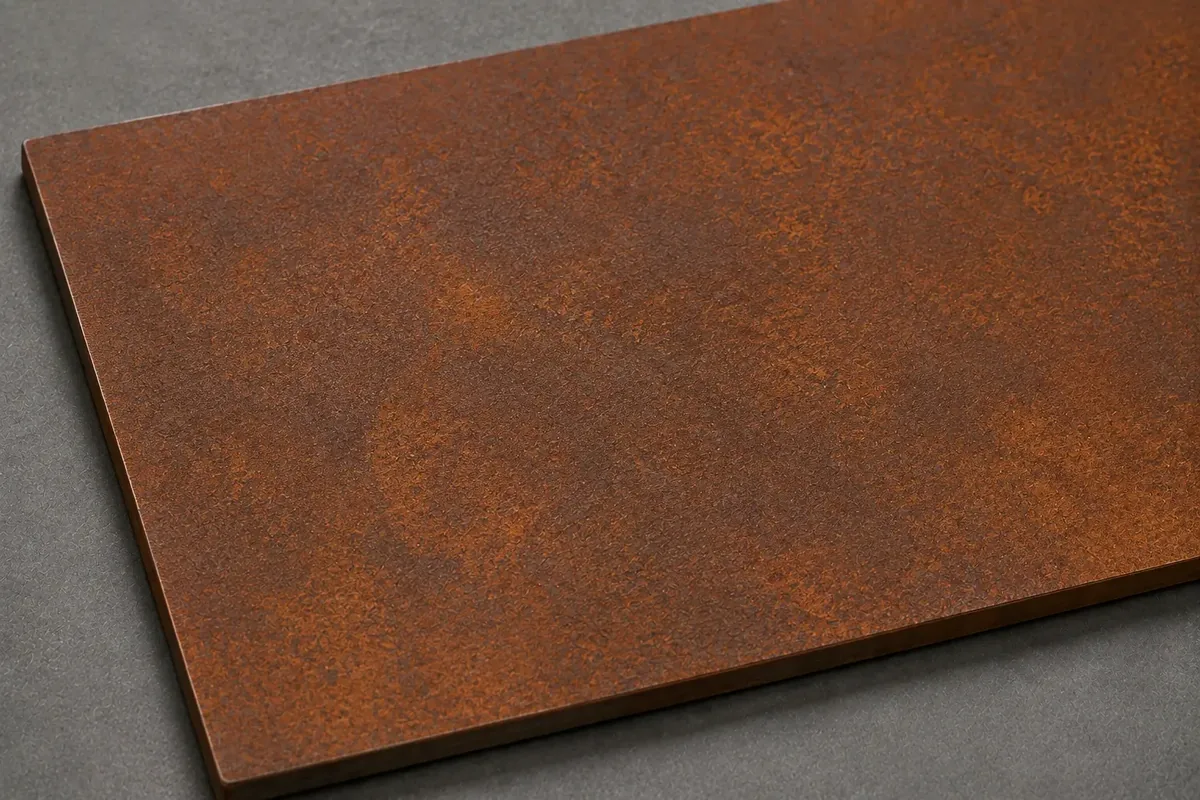
New weathering steel arrives grey with mill scale. It goes through orange, then a coarser textured rust, and settles toward a darker brown-purple over a period that depends entirely on exposure, orientation and how much rain the surface actually gets. Sheltered faces develop differently from exposed ones on the same object, so a single piece frequently has more than one tone.
We will not give you a fixed timeline for that. Anyone who does is guessing, because the same panel behaves differently on a south elevation and in a shaded courtyard. What we can do is show you material at different stages and be clear about the range.
Detailing for Drainage
Because the material depends on drying, detailing decides its service life more than thickness does.
Sections should drain rather than hold water — weep holes at the base of hollow sections and at any point where water can collect. Horizontal surfaces that pond are the enemy. Contact with soil accelerates corrosion at exactly the point you cannot inspect, so a planter that sits directly in wet earth without a liner or a break will fail at the base first. Fasteners should be compatible, and stainless fixings in weathering steel are a deliberate decision with a visual consequence.
Finish, and Why Corten Does Not Take One
Corten is the one metal we work that arrives with its finish already decided. The weathering patina is the corrosion protection, so coating it defeats the entire reason for choosing it.
- Leave it alone. The patina develops over roughly six to eighteen months depending on exposure, going from bright orange through rust red to a stable dark brown. Wet-dry cycling is what drives it, so a sheltered face will take longer and stay lighter than one in the open.
- Sealing is possible and usually a mistake. A clear sealer will hold the colour at whatever stage you liked, and it will also fail unevenly in a few years and leave you with patches. We will do it if asked and we will tell you first.
- The run-off is the design problem, not the metal. For the first year corten stains whatever sits beneath it. Concrete, pale pavers and light stucco all take it permanently. This is solved at drawing stage with a drip edge, a gravel margin or a sacrificial first year, and it cannot be solved afterwards.
If you want the aged look indoors, where corten will never develop properly, an applied patina on steel is the finish that gets you there. For the full comparison, see metal finishes.
Related Products
Weathering steel is most often used on planters, privacy and architectural screens and fence panels, and it appears in landscape edging and site elements specified by landscape architects. How the material behaves in a planter specifically — liners, drainage, rooftop use — is covered on the planters page.
Free in-house consultation
We come to you, measure the site, and talk through options and budget before you commit to anything. No charge, no obligation.
Call (778) 805-5333 or email sales@trussmetal.com